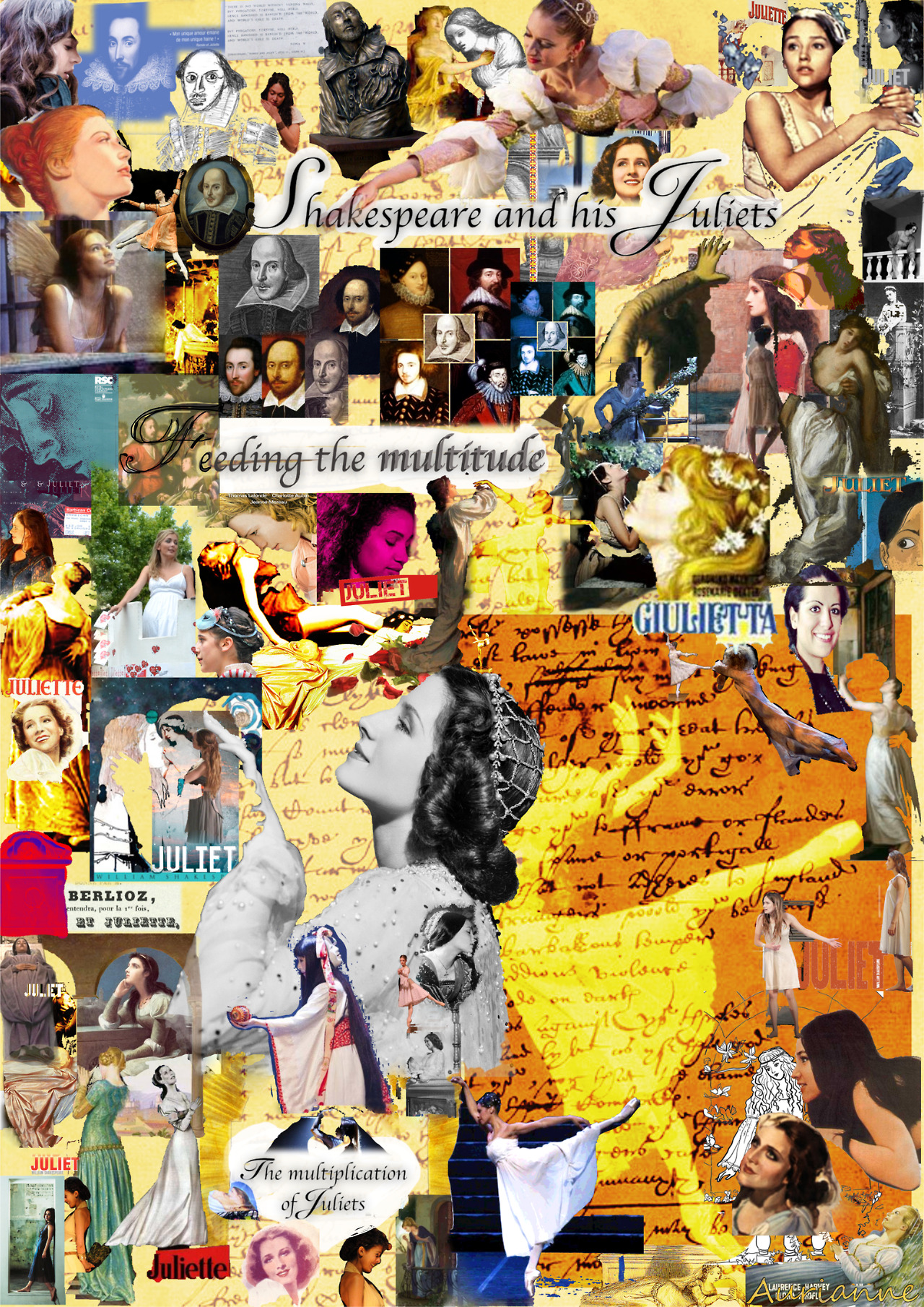
Feeding a Multitude – The multiplication of Juliets
This document deals with the meaning of the word “Shakespeare”.
At first, we assume it refers to a man living in the late sixteenth and early seventeenth centuries in England. But if we take a closer look, we realize that Shakespeare cannot refer to one single man, as the study of the handwriting proves it as well as the number of plays written under his name. His actors and other playwrights, like Sir Thomas More, Edward the Vere, Sir Francis Bacon, Christopher Marlowe, William Stanley or Roger Manners have probably contributed to the works of Shakespeare the way people working for Pierre Cardin have contributed to all the clothes produced under his name. That is a theory. But, as Bill Bryson puts it in Shakespeare, “When we reflect upon the works of William Shakespeare it is of course an amazement to consider that one man could have produced such a sumptuous, wise, varied, thrilling, ever-delighting body of work, but that is of course the hallmark of genius. Only one man had the characteristics and gifts to give us such incomparable works, and William Shakespeare of Stratford was unquestionably that man-whoever he was.”
Shakespeare’s plays have fed the imagination of millions of audiences around the world. He has literally fed a multitude artistically.
So, it is possible to state that the word Shakespeare doesn’t refer to this man living in the late sixteenth and early seventeenth centuries anymore but to the overall artistic production made under his name or thanks to it, and also to the critics, scholars, teachers and translators who managed to keep the text accessible, understandable, interesting and open.
As a proof for this idea, I have decided to collect a few of Shakespeare’s Juliets in order to show how multiple, how numerous and last but not least how diverse they are. Romeo and Juliet’s death-marked love echoes the immortal love people devote to Shakespeare.
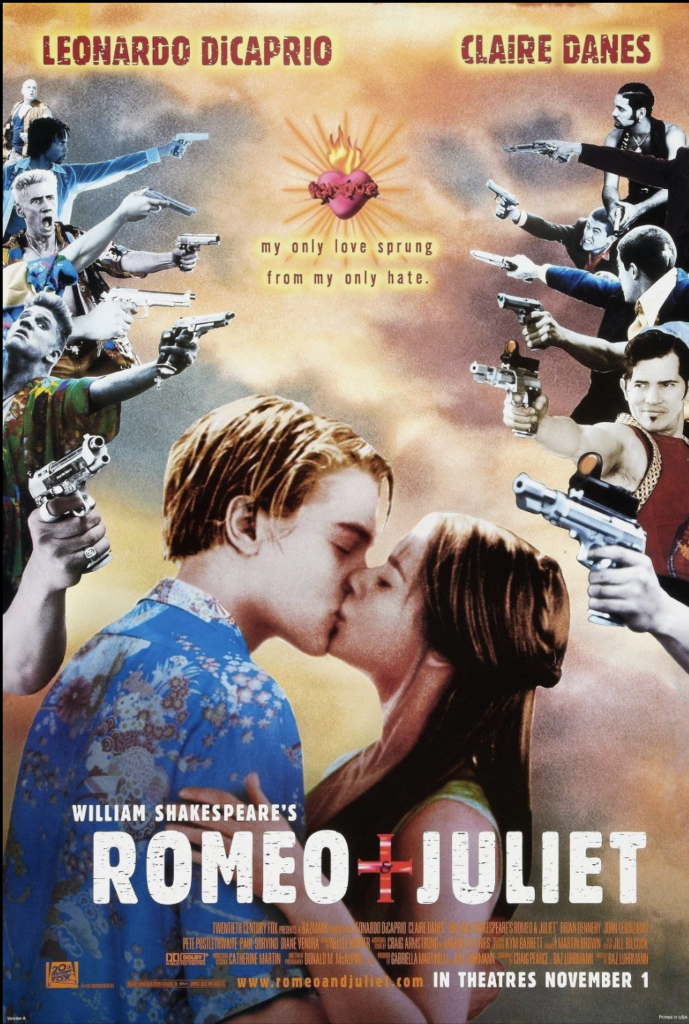
Romeo + Juliet – 1996 –
Baz Luhrmann: https://www.imdb.com/title/tt0117509/?ref_=nv_sr_srsg_0_tt_5_nm_3_in_0_q_romeo
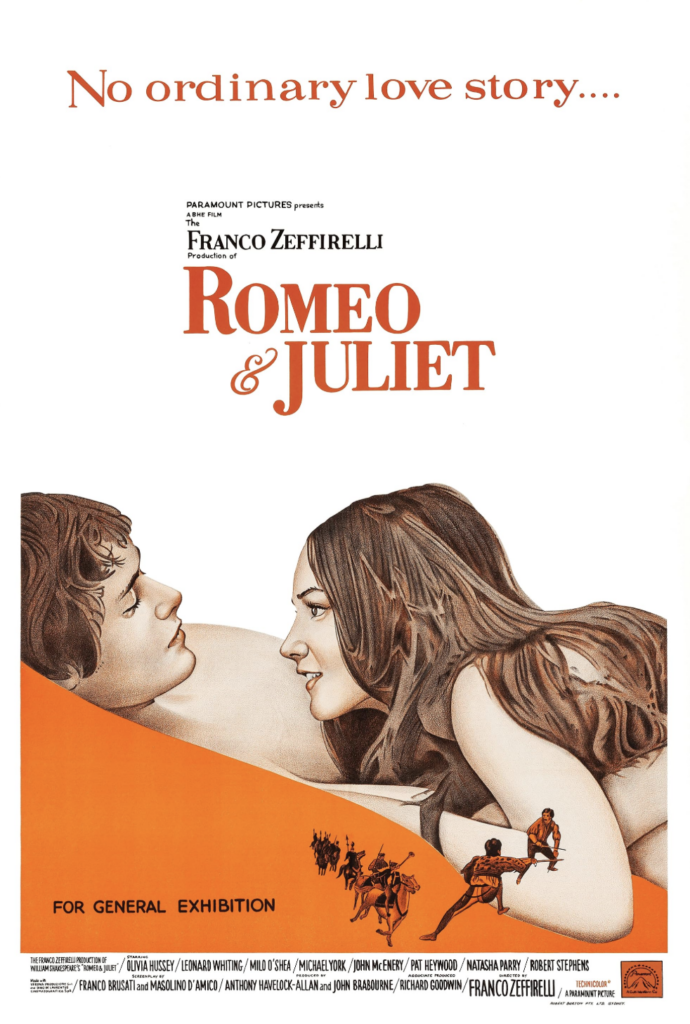
Romeo and Juliet – 1968 –
Franco Zeffirelli: https://www.imdb.com/title/tt0063518/
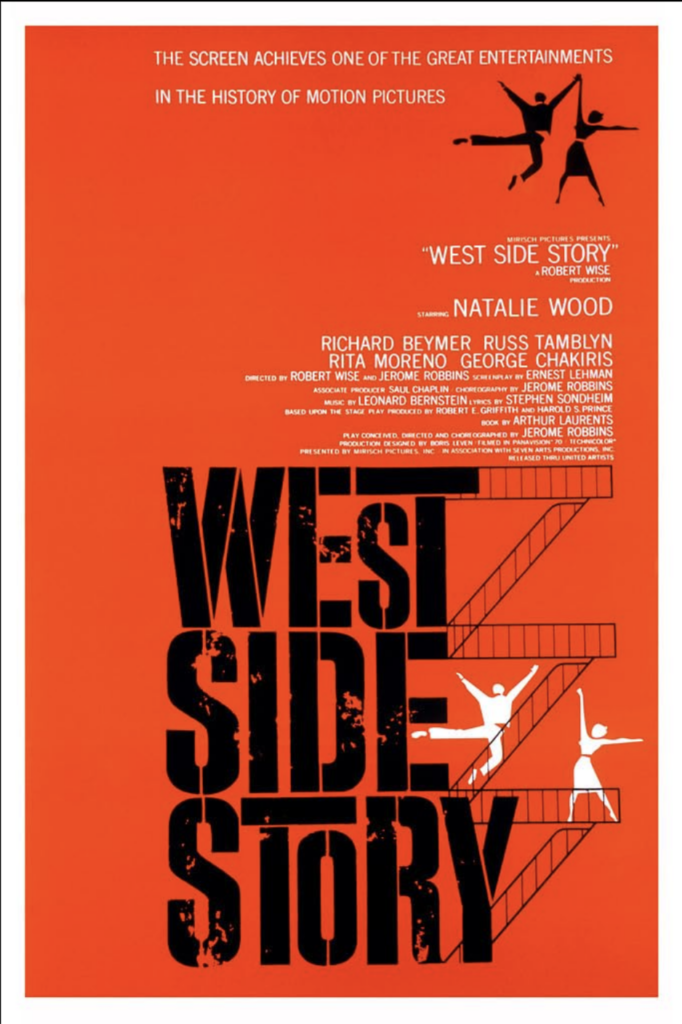
West Side Story – 1961: https://www.imdb.com/title/tt0055614/
Ghostlight – 2024 –
Kelly O’Sullivan & Alex Thompson: https://www.imdb.com/title/tt30321095/
Romeo and Juliet – Wikipedia: https://en.wikipedia.org/wiki/Romeo_and_Juliet
The Tragedy of Romeo and Juliet, often shortened to Romeo and Juliet, is a tragedy written by William Shakespeare about the romance between two young Italians from feuding families. The appeal of the young hero and heroine—whose families, the Montagues and the Capulets, respectively, are implacable enemies—is such that they have become, in the popular imagination, the representative type of star-crossed lovers.
The terms “star-crossed” and “star-crossed lovers” refer to two people who are not able to be together for some reason. These terms also have other meanings, but originally mean that the pairing is being “thwarted by a malign star” or that the stars are working against the relationship. The phrase stems from the astrological belief that the positions of the stars ruled over people’s fates. Such pairings are often said to be doomed from the start.
The play has many sources. Romeo and Juliet borrows from a tradition of tragic love stories dating back to antiquity.
There are several versions of the play.
Romeo and Juliet is the most famous love story in the English literary tradition.
The title characters are regarded as archetypal young lovers.
It was among Shakespeare’s most popular plays during his lifetime. Romeo and Juliet ranks with Hamlet as one of Shakespeare’s most performed plays. Of Shakespeare’s works, Romeo and Juliet has generated the most—and the most varied — adaptations, including prose and verse narratives, drama, opera, orchestral and choral music, ballet, film, television, and painting. Romeo and Juliet is one of Shakespeare’s most-illustrated works. Romeo and Juliet may be the most-filmed play of all time. Romeo and Juliet was even adapted into manga format.
Romeo and Juliet had a profound influence on subsequent literature. Before then, romance had not even been viewed as a worthy topic for tragedy.
The word “Romeo” has even become synonymous with “male lover” in English.
In architecture, a Juliet balcony (or Juliette balcony) is a balustrade connected to the façade of a building. The word balcony didn’t exist in Shakespeare’s time. Originally, Juliet appeared at a window.
Two of Uranus’s moons, Juliet and Mab, are named after the play.
For All Time – A human face made from 2,000 handmade stars, suspended in the Swan foyer, by artist and designer Steven Follen – RSC: https://www.rsc.org.uk/your-visit/see-for-free/for-all-time
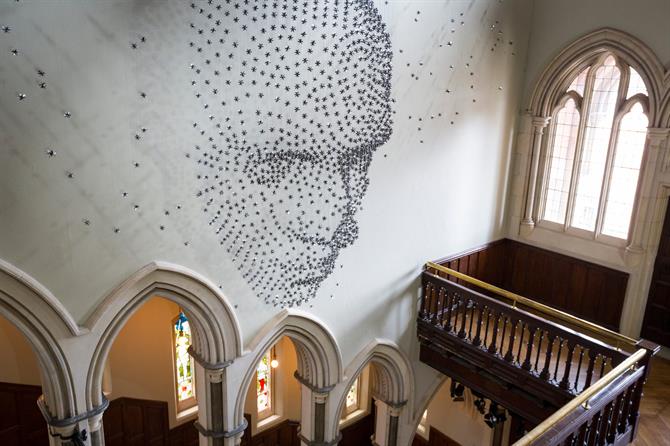
Romeo and Juliet, Act 3, Scene 2:
“And when I shall die,
Take him and cut him out in little stars,
And he will make the face of heaven so fine
That all the world will be in love with night
And pay no worship to the garish sun.”
Dire Straits – Romeo And Juliet (Official Music Video): https://youtu.be/rC95MEenIxA?si=QfwFjSH0pSuFn-k2