Don’t think, don’t try to understand,
Just watch.
Un gars une fille – one episode a day (6 min): https://www.youtube.com/results?search_query=un+gars+une+fille
Imdb: http://www.imdb.com/title/tt0217224/fullcredits?ref_=tt_ov_st_sm
Watch Arte with French subtitles: https://www.arte.tv/fr
Listen to the radio – Radio France: https://www.radiofrance.fr/
Apprendre le français avec TV5 Monde – videos followed by a few questions – ideal to learn how to pick up information in a video without understanding it all – There are different levels: A1, A2, B1, B2, C1, C2. The easiest level is A1, the most difficult C2.: https://apprendre.tv5monde.com/fr
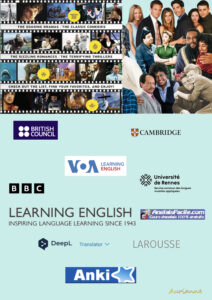
The Anki App to make flashcards to learn vocabulary and complete sentences – Use it daily: https://apps.ankiweb.net/
Use Deepl or Larousse to translate what you do not understand, then put these words / sentences in an Anki flashcard to learn them: https://www.deepl.com/en/translator and https://www.larousse.fr/dictionnaires/francais-anglais
When learning, be precise and memorize the exact words and phrases.
Enjoy every opportunity to practice: read, listen, speak and write. Join or create a club or an association in order to meet people who speak French. When you speak, don’t be afraid of making mistakes – it’s perfectly normal. We also make mistakes in our native language, even if it’s less often and it’s often funny. The key is to understand and make yourself understood. Ask questions to figure out the meaning of anything you don’t understand. There’s no pressure: foreigners speak by making mistakes, and that’s how languages evolve! You’re not a spy. You don’t risk your life if you have an accent or make a mistake! Laugh and make others laugh! When you were little and learning your native language(s), you made the adults laugh!
A brief history of language teaching – Languages Road show: https://www.languagesroadshow.com.au/a-brief-history-of-language-teaching
Why Scandinavians speak exceptional English – The polyglot dream: http://www.thepolyglotdream.com/scandinavianenglish
The Scandinavian Countries: Why Are They So Good At Speaking English?: https://crystalcleartranslation.com/the-scandinavian-countries-why-are-they-so-good-at-speaking-english/#:~:text=Constant%20exposure%20to%20the%20English,acquisition%20of%20foreign%20language%20skills
It’s best to stimulate children under the age of 6 with fun activities in the target language that the child will enjoy: a picture book, games, nursery rhymes, videos, conversations, etc. For example, you can start with easy videos like Pocoyo or Dora l’exploratrice translated into French, then show videos or songs or games or books that the child enjoys. Talking to your child in French is very effective, even if they respond in their native language. Don’t force them, but encourage them when they do understand. The key is to remain natural and not make a big deal out of it.
Don’t expect to see results before 2-3 years of learning. Children learn but don’t show their progress. Don’t push them. Encourage them by emphasizing on what they have understood and telling them that it’s okay if they don’t understand everything. This exposure to the target language will make it easier for them to learn the language later on.
“The ideal age for learning a foreign language is between 3 and 6. This is the period when the brain is most receptive and able to be shaped. Since children act a lot by mimicry, this would greatly facilitate the learning of a second language.
At this age, children are often considered to be veritable “sponges” (…)
Anyway, learning should always be based on playful, oral techniques (imaginary books, games, nursery rhymes, etc.) to arouse the child’s curiosity and keep his or her full attention.” Learning a foreign language: from an early age.. – FLE.fr: https://www.fle.fr/Apprendre-une-langue-etrangere-des-le-plus-jeune-age#:~:text=L’%C3%A2ge%20id%C3%A9al%20for%20learning,learning%20a%20second%20language.
Learning several languages – Naître et Grandie: https://naitreetgrandir.com/fr/etape/1_3_ans/langage/ik-naitre-grandir-parole-langage-enfant-apprentissage-plusieurs-langue-bilinguisme
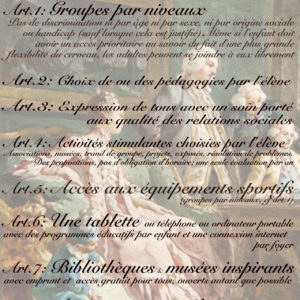
Languages should be taught at school before the age of six.