The play
Julius Caesar by William Shakespeare is based on Sir Thomas North’s 1579 translation (via a French version) of Plutarch’s Bioi parallēloi (Parallel Lives), the drama takes place in 44 BCE, after Caesar has returned to Rome.
Fearing Caesar’s ambition, Cassius forms a conspiracy among Roman republicans. He persuades the reluctant Brutus — Caesar’s trusted friend — to join them. Brutus, troubled and sleepless, finds comfort in the companionship of his noble wife, Portia. On the fifteenth of March, Calphurnia, Caesar’s wife,
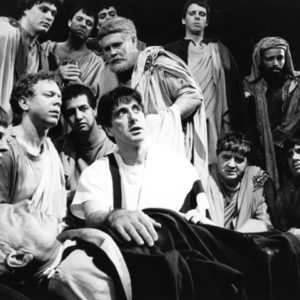
alarmed by prophetic dreams, persuades Caesar to stay home because she fears for his safety. Decius Brutus, arriving to accompany Caesar to the Capitol, convinces him that the senators plan to crown Caesar that day but that they may never renew their offer should they suspect he is afraid. “ This dream is all amiss interpreted”. Decius is flattering. Caesar changes his mind and decides to go. Caesar ignores the bad omens: the dead have climbed up from their graves, his wife Calpurnia has dreams, there was no heart in the sacrificed animal. His ideal is that he has no fear and that is why he goes. He is joined by Brutus and the rest of the conspirators, as well as by Mark Antony. Then, as planned, Caesar is slain in the Senate on March 15, “the ides of March.” His friend Mark Antony, who has expediently shaken the bloodied hands of the conspirators, gives a stirring funeral oration that inspires the crowd to turn against them. Octavius, Caesar’s nephew, forms a triumvirate with Antony and Lepidus; Brutus and Cassius are eventually defeated at the Battle of Philippi, where they kill themselves to avoid further dishonour.
Julius Caesar is not the main character but he is the central motif around which the others operate. The story is about the power struggles around him. He has around 100 lines and dies half way through. This is unlike most of Shakespeare’s tragedies where characters die at the end. This is repeated throughout history and historical tragedies: a tyrant is killed because he does not defend the interests of the people and leaves his place not to the people but to another tyrant. Julius Caesar defends the interests of the people and yet, he is killed. In this play, the conspirators, who only care about their own power, die at the end. We can conclude that Julius Caesar is the tragedy of the Roman Republic. Order is restored in the final scene when the conspirators are defeated and Octavius is named the successor.
In Antony and Cleopatra, Antony also dies before the end, after blindly following Cleopatra’s boat and abandoning battle against Rome, thus choosing Egypt before Rome. Cleopatra dies at the end, poisoning herself with a snake. She is not mentioned in Julius Caesar. The order is restored by Octavius at the end of the play. Rome wins. Octavius becomes the first Roman emperor.
When Caesar says ‘Do this,’ it is performed”; such authority is the mark of a powerful leader (I.ii.12). Julius Caesar represents the ideal, the people, the embodiment of Rome. He is very noble. He stands for Rome. People love him. The first scene is a triumph of Caesar. Caesar is a good ruler. In this way, Shakespeare pleases Queen Elizabeth I because the ruler is noble and virtuous. There is chaos after the murder of the ruler, even poets are killed. That should dissuade anybody to kill the ruler. Elizabeth is old and with no heirs, so she is in a difficult position.
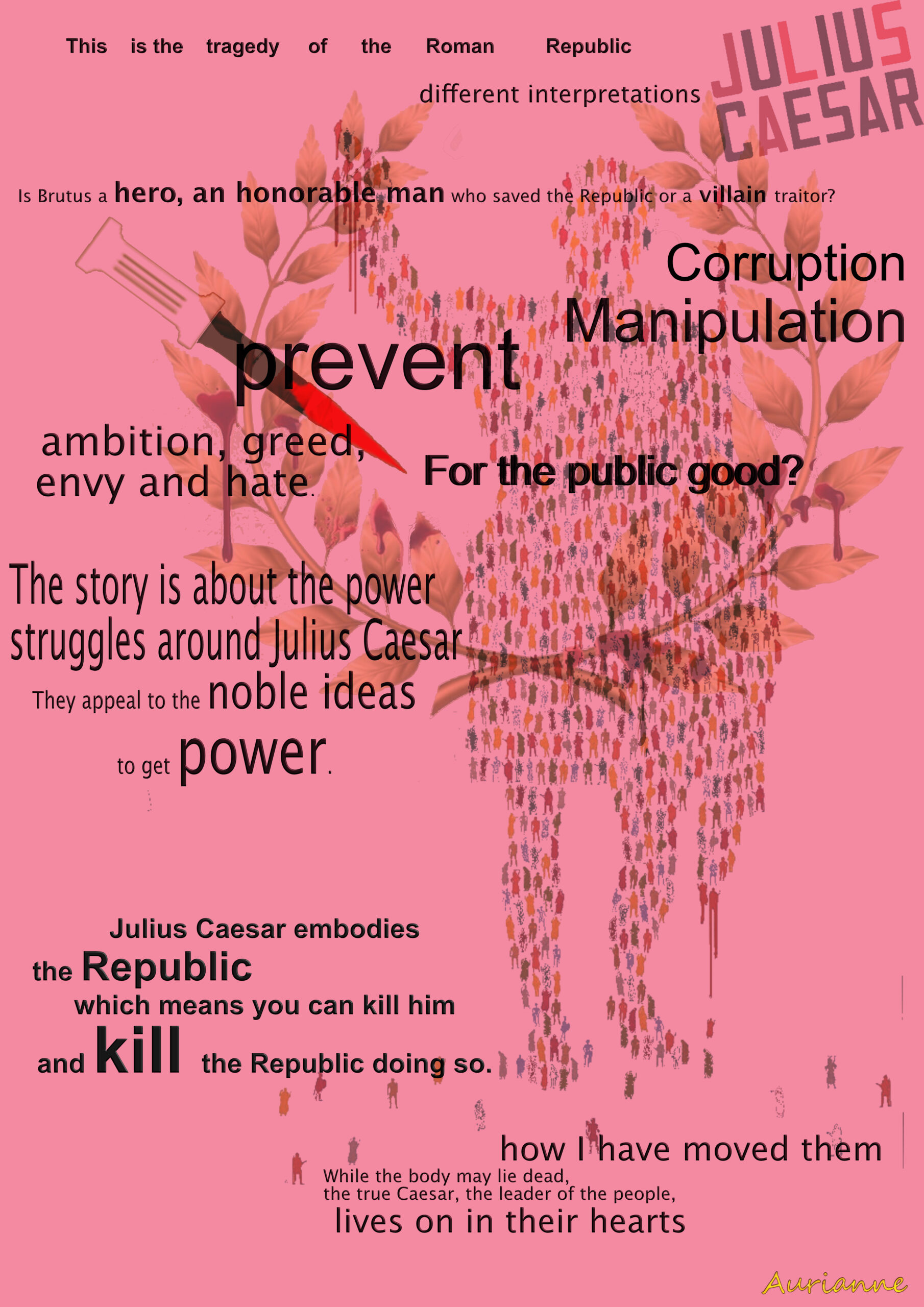
Julius Caesar embodies the Republic – which means you can kill him and kill the Republic doing so. He is “one only man” and there is corruption around him. If there is a crown, there is a dagger that can destroy the political power.
There is no sign Caesar may become a tyrant in Brutus’ eyes. Yet, Caesar has crossed the Rubican, he is dictator for life, he’s been offered a crown, he bosses Senators, he refers to himself to the third person, he calls the senate my senate, he even says “I don’t need to give you any reason my will is enough”.
He says he constant like the North star which reveals his sense of invulnerability but there are different interpretations for Calphurnia’s dream, he is manipulated and Julius Caesar does change his mind and goes to the Senate.
He has weaknesses: he is epileptic, he had to be saved from water by Cassius, he is deaf on the right ear. He is human. Caesar is playing the role of a constant man who cannot be moved by prayers, he aspires to be a God. But each time, Shakespeare shows his weaknesses, undermining his declarations.
“The question of Caesar’s own ambition is raised in Casca’s account of the triumphal procession. In describing how Antony offered Caesar a crown three times, Casca makes sure to point out Caesar’s reluctance in refusing the crown. Since the incident is related from Casca’s anti-Caesar perspective, it is difficult to ascertain Caesar’s true motivations: did Caesar act out of genuine humility or did he merely put on a show to please the crowd? Nevertheless, Casca’s mention of Caesar’s hesitation suggests that, no matter how noble his motivations, Caesar is capable of being seduced by power and thereby capable of becoming a dictator, as Brutus fears.” Sparknotes
Julius Caesar gains in momentum becoming a colosse, divine and a ghost.
“And this man
Is now become a god, and Cassius is
A wretched creature, and must bend his body
If Caesar carelessly but nod on him.
He had a fever when he was in Spain,
And when the fit was on him, I did mark
How he did shake–‘tis true, this god did shake” Act 1, Scene 2.
“Then fall, Caesar!” are his last words. Order falls with him. Caesar narrates his own fall on the 3rd person. As a man he is fragile but as a spirit, he is constant. By killing the man, the spirit is immortalized. He becomes like a God after his death.
While the body may lie dead, the true Caesar, the leader of the people, lives on in the pleb’s hearts—as he does in the anxious minds of the conspirators: Brutus will soon encounter Caesar’s ghost near the battlefield.
Cassius is the leader of conspirators. He is motivated by envy and greed of power. He uses the argument of the fear that Julius Caesar would become a tyrant in order to manipulate the others. He is ambitious while he blames Julius Caesar to be. He is not a noble who acts for the common good of Rome, he would be a bad ruler.
He is perceived as dangerous by Julius Caesar. Cassius has a practical reason. He praises Brutus with flattery. He is a great manipulator.
Cassius is motivated by envy. He refers to Brutus’ pride and lineage. He needs Brutus to make his action look like a tyrant slaughter. He turns a private conspiracy in the shadows to something that appears to be asked by the general will. They want to appear as liberators.
Shakespeare shows that most politicians are self-centered and motivated by ambition, greed, envy and hate. They do not care about what is best for Rome. They oppose Julius Caesar’s kingship not because he would make a poor leader, but because his leadership would preclude their own.
Marc Antony and Caesar are champions of the people.
Mark Antony is a good speaker and is powerful. Mark Antony’s speech after Julius Caesars death is incredible. It is a rhetorical tour de force. He is manipulating the pleb to defend Caesar by playing all the emotions. Rhetoric is used to acquire power. He uses inclusive terms, “Friends, romans, countrymen”, repetition “ambitious”, “honourable”. He lies when he says he saw Caesar’s reaction to Brutus’ killing as he wasn’t there. He is ambitious and sees the opportunity to gain power. He appeals to the noble ideas to get power. He stands that Caesar was the noblest man, while the Caesar we’ve seen in the first act is an old man, frail, easily confused and human. By saying Brutus was “an honourable man,” he uses the power of insinuations, like Iago saying Cassio is not honest in Othello. Antony says that they should not be stirred to mutiny against such “honourable men”. He pretends he agrees with the conspirators and then he moves the crowd against them. He is an actor, he lies, he faints emotions. He speaks in verse and repeats again and again that Brutus and the conspirators are honorable men; the phrase “Brutus says he was ambitious, / And Brutus is an honourable man” accrues new levels of sarcasm at each repetition. He effects the exact opposite of what his words say. Thus he accuses the conspirators not to be honorable. He claims that Julius Caesar has refused the crown thrice and that in his will, he gives money to the pleb thus demonstrating there was no good reasons to kill him. “I thrice presented him a kingly crown, Which he did thrice refuse. Was this ambition? ” Act 3, sc 2. The crowd is convinced. “tis certain he was not ambitious”.
Antony wants to show himself as a man of the people. He needs the consent of the crowd. Antony can not criticize the conspirators openly and he makes the pleb ask him to read the will.
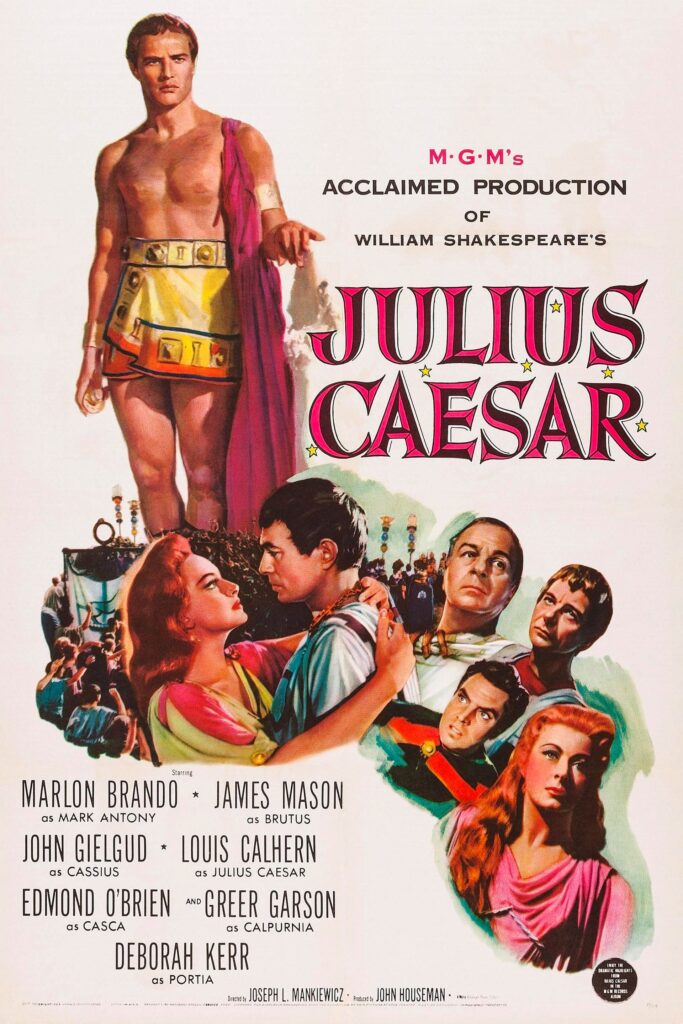
Julius Caesar (1953) – Mark Antony’s Forum speech (starring Marlon Brando): https://youtu.be/101sKhH-lMQ?si=Ky2O0ODk9FJLzWg8
Brutus is the main character of the play. Brutus is considered noble and pure and he seeks the common good but he is manipulated by the other characters. He loves and is loved by Caesar. He has the most reasons to love Caesar: he is a father figure and Caesar forgave him about fighting on Pompei’s side.
Brutus is wrong when he thinks Mark Antony can do no harm. Cassius reasons better than Brutus does. Act III, scene ii evidences the power of rhetoric and oratory: first Brutus speaks and then Antony, each with the aim of persuading the crowd to his side. They show the power that words can have even when they claim that they do not: “my weak words”, “no orator like Brutus”.
Brutus makes the mistake of not including Cicero and Mark Antony because Brutus can’t bear being commanded.
Brutus’ nobility brings him to his crash because he is too innocent. He thinks Julius Caesar must die for the good of the people. He thinks too much power will change Caesar. He wants to “put a sting in him, that at his will he may do danger with””a serpent’s egg”. Angelo in Measure for Measure has excellent reputation, and yet he behaves poorly once he’s got power. How can we know if Caesar will be the same? Brutus is led by fear of what Julius Caesar could be. With this reasoning, everybody could be killed by fear of what they could become.
It must be by his death. And for my part
I know no personal cause to spurn at him,
But for the general. He would be crowned:
How that might change his nature, there’s the
question. Act 2 sc 1
The ancestor of Brutus was a tyrant slaughterer.
Brutus is turned into doing something that is bad for the people even if his intent was to do good.
Cassius wants to kill Mark Antony too. Brutus disagrees because he sees them like priests before gods: “Let’s all be sacrificers, but not butchers, Caius”. He clearly sees himself as a savior. Brutus cares about appearances rather than saving the republic: “purgers, not murderers”. After Julius Caesar’s death, his speech is full of facts and logic and he shows the noble aim he has.
He acts on his passions, he does not gather enough evidence to make reasonable decisions, and is manipulated by Cassius and the other conspirators. Brutus is manipulated by other people’s envy, to kill who he loves, like Othello. To know whether or not Caesar will be corrupted by his power, there are false evidences: Brutus is given forged letters. It is the equivalent of the handkerchief in Othello.
He did not kill Caesar out of a lack of love for him, he says, but because his love for Rome outweighed his love of a single man. “Why I, that did love Caesar when I struck him,” Act 3 sc 1
He cannot sleep after killing his ruler, like Macbeth. Contrary to the Macbeths who wash blood from their hands, the conspirators plunge their hands into Julius Caesar’s blood. The Macbeths’ motive is their personal interest, and they hide the crime. The conspirators of Julius Caesar are proud of their killing. They say that it is for the common good and present themselves as saviors. “Let us bathe our hands in Caesar’s blood (…) Let’s all cry, “peace, freedom and liberty”” But they real motive, apart from Brutus, is personal interest, like the Macbeths.
Brutus says one does not see himself through his own eyes, but through the viewpoints of others.
“Cas. Tell me, good Brutus, can you see your face?
Bru. No, Cassius; for the eye sees not itself
But by reflection, by some other things.
Cas. ‘Tis just,
And it is very much lamented, Brutus,
That you have no such mirrors as will turn
Your hidden worthiness into your eye,
That you might see your shadow. I have heard
Where many of the best respect in Rome
(Except immortal Caesar), speaking of Brutus
And groaning underneath this age’s yoke,
Have wish’d that noble Brutus had his eyes.
Bru. Into what dangers would you lead me, Cassius,
That you would have me seek into myself
For that which is not in me?
Cas. Therefore, good Brutus, be prepar’d to hear;
And since you know you cannot see yourself
So well as by reflection, I, your glass,
Will modestly discover to yourself
That of yourself which you yet know not of.” Act 1 sc 2
At the battle of Philippi, while Brutus claims that his honor forbids him from raising money in unscrupulous ways, he would still use such money as long as it was not he himself, but rather Cassius, who raised it. Brutus asks Cassius if they should now allow themselves to descend into the very corruption that they tried to eliminate. Brutus speaks against corruption, but when he has no other means of paying his army, he quickly consents to unscrupulousness, if only indirectly. “There is a tide in the affairs of men (. . .)And we must take the current when it serves . . .” Act 4 sc 3
Brutus cares about appearances, about how his actions would look like rather than acting for the common good.
Brutus:”Our course will seem too bloody, Caius Cassius,
To cut the head off and then hack the limbs,
Like wrath in death and envy afterwards;
For Antony is but a limb of Caesar.
Let’s be sacrificers, but not butchers, Caius.180
We all stand up against the spirit of Caesar,
And in the spirit of men there is no blood.
O, that we then could come by Caesar’s spirit
And not dismember Caesar! But, alas,
Caesar must bleed for it. And, gentle friends,185
Let’s kill him boldly, but not wrathfully.
Act 2 sc 1
This shall make
Our purpose necessary and not envious;
Which so appearing to the common eyes,
We shall be called purgers, not murderers. Act 2 sc 1
The gohst of Caesar is avenging himself. Brutus realises he made a big mistake. His nobility is aknowledged. He has been played. Brutus takes his own life.
Is Brutus a hero who saved the Republic or a villain traitor? Brutus can be seen either as a selfless fighter against dictatorship or as an opportunistic traitor.
The pleb represent the audience who is moved back and forth thus showing how easily moved we are. They are manipulated by the politicians with ideals while these politicians only seek personal power. The naives are crushed.
“The first scene of the play clearly illustrates the fickleness of the multitude, which hastens to cheer Caesar’s triumph over a man whom it once adored. Surely the conspirators run a great risk by letting such a fickle audience listen to the mournful Antony. Yet, blinded by his conception of the assassination as a noble deed done for the people and one that the people must thus necessarily appreciate, Brutus believes that the masses will respond most strongly not to Antony’s words but to the fact that the conspirators have allowed him to speak at all. Because he feels that he himself, by helping to murder a dear friend, has sacrificed the most, Brutus believes that he will be respected for giving priority to public matters over private ones. We will see, however, that Brutus’s misjudgment will lead to his own downfall: he grossly underestimates Antony’s oratorical skill and overestimates the people’s conception of virtue.” Sparknotes
The mob is fickle, they follow the last one who spoke.
History
The Roman Republic was installed after the Roman kingdom was overthrown in 509 BC and lasted until 27 BC. But over the last 50 years, landowners had become extremely wealthy. They owned so much land that they could control the price of wheat by hoarding it when it was cheap and selling it at inflated prices when it was expensive.
As a result, a large part of the population was much poorer. There were revolts. The plebs began to win elections. So the ultra-rich took up arms and appointed a general named Pompey. (The same thing happened in Spain in the 20th century when the Republicans won the elections and the rich went to find Franco). Caesar was leading the fighting pleb and Pompei the rich owners. Ten years of civil war followed, with numerous massacres. Because of the war, the plebs needed a military champion. Caesar became the defender of the plebs and the Republic. Caesar won.
When he returned to Rome, the elected representatives of the popular parties had become bourgeois and no longer wanted to implement the social reforms for which they had been elected. Caesr was frustrated that the new elected elites behaved like the rich before them. He expressed his frustration and will to use his influence to push for the Gracchi laws to be adopted to limit how wealthy a citizen could be. He was faced with the issue that the senators wouldn’t probably vote against their own interests. The Republic was unable to solve its problem with the rich. Caesar was very popular among the Roman public who saw him as an effective leader and the senate as a corrupt aristocracy.
The Republic weakened during the Civil War. The civil war left Caesar in a position of near-unchallenged power. Julius Caesar’s rise to the powerful position of consul, years of military triumphs had made him the wealthiest man in Rome. His power was at its peak. The title of dictator gave him temporary emergency powers in wartime. In early 44 BC, he was proclaimed “dictator for life” (dictator perpetuo), dictator for unlimited time. Dictator at the time meant leader of the executive power, who can rule by decree but cannot contradict the laws of the senate; like a president in a social democracy.
Caesar was accused of becoming a tyrant. Fearful of his power, domination of the state, and the possibility that he might make himself king, a group of senators assassinated Caesar on the Ides of March (15 March) 44 BC. Leading them were the senator Gaius Cassius Longinus and Brutus, his brother in law. Brutus who had sided Pompey during the civil war and for whom Caesar had intervened to save his life, Brutus who had become a close advisor to Caesar. Brutus claimed descent from Lucius Junius Brutus who had helped overthrow the tyrannical king known as Tarquin the Proud. The elder Brutus led the people in a rousing oath to never again allow a king to rule. No one man should hold too much power.
It was the senators, who supported the ultra-rich, who assassinated Caesar. It was a group of conspirators who called themselves the liberators. He has been stabbed 23 times. The assassins barricaded themselves on the Capitoline Hill. Mark Antony, who was co-consul, delivered a passionate speech at Caesar’s funeral, days later that grieved the crowd. The liberators were forced out of Rome. The triumvirate of Lepidus, Octavian and Mark Antony were given dictatorial power by the senate as successors of Julius Caesar as chief of the executive branch.
This led to chaos in the country. It was the end of the Republic. The ensuing power vacuum led to a series of civil wars.
Julius Caesar – Wikipedia: https://en.wikipedia.org/wiki/Julius_Caesar
“A new series of civil wars broke out and the constitutional government of the Republic was never fully restored. Caesar’s great-nephew and adoptive heir Octavian, later known as Augustus, rose to sole power after defeating his opponents thirteen years later. Octavian then set about solidifying his power, transforming the Republic into the Roman Empire.”
All the social reforms that the plebs wanted were implemented by Caesar’s adopted son, Octavian, who succeeded him and became Augustus, the first emperor. The head of state was the head of the army. He collected taxes and redistributed the money. He appointed some of the senators. The citizens appointed the others.
Augustus carried out the agrarian reform of the Gracchus brothers to limit the amount of land that could be owned. In effect, this limited wealth.
Ideas
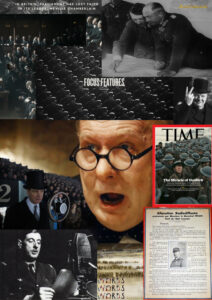
Each time people defend the common good, they are attacked by a strong reaction which leads to periods of chaos. A champion is then needed to defend the country. The republican ideal is that the nation doesn’t belong or rely on a specific individual and therefore lives with its people. Choosing a champion weakens the republic.
Julius Caesar faced the same dilemma when defending the interests of the people. Julius Caesar concentrated power in his own hands to defend the people’s interests, but thereby weakening the republic. How can we escape this dilemma?
The French Revolution was followed by chaos: terror and beheadings, but in the long run its ideas won by gaining ground. The French army needed Napoleon because the monarchies of Europe wanted to kill the Revolution. A leader was needed to defend the country against the aggressions of the other countries.
After the revolution in Russia, other countries armed the counter-revolutionaries, which created a civil war. The Bolshevik Revolution was met with resistance from the White Russians, which led to years of civil war and the establishment of military rule. Staline became the champion with non-democratic consequences. He did not defend the will of the people.
Since George Washington introduced himself as the father of the nation in the United States, he weakened the new republic by making it more reliant on an individual.
De Gaulle saved the republic from dictatorship but established the notion that the head of state is a monarchical figure. The republic was weaker because it needed a savior.
Général de Gaulle :”Je ne commence pas une carrière de dictateur” : https://youtu.be/eIreF_5GM0U?si=USaxS9ynBcRiRLkD
The Arab revolutions and the May 1968 movements created democratic, pacifist, and environmentalist aspirations that survive today but generated a very strong reaction of repression, and it is too early to see the fruits of these movements. In people’s minds, this desire for change still exists.
But ideas progress despite everything. There is more and more democracy, even if the reactionaries try to stifle it. History moves forward in fits and starts, but democracy progresses.
If you saw one man gaining too much power, would you try to stop him? Even if that man was one of your closest friends and allies? Absolute power can often corrupt people, change them, but it is not automatic. Chaos follows when a leader dies and there is no clear successor. A champion is then needed to restore order. How can you guarantee that the leader will defend the people’s interests? How do you know if power will change him? How can you have a republic that does not need to be embodied in order to defend itself?
The play is an examination of the dangers of desiring power and how it can change politicians. It is also an example of how people who hold power should act by serving the people’s interests. How can we know if a politician will defend ideals to serve the people or of he will only care about his own power?
The people has to be brave enough to vote for the candidates who defend the people.
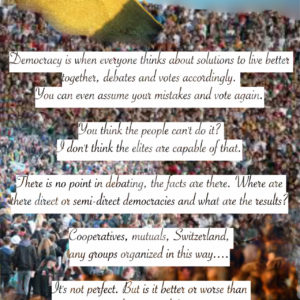
Swiss direct democracy seems to prevent a minority from acquiring too much wealth or power, at least not to an extreme degree. This results in greater stability, which helps to prevent internal crises.
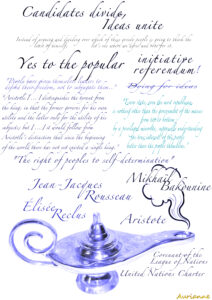
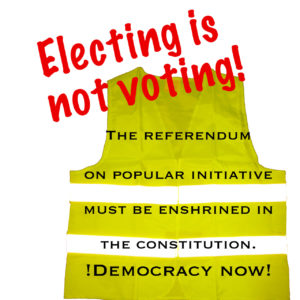
Can direct democracy help the leaders to defend the people’s interests while defending the country against selfish tyrants? Shouldn’t we debate ideas rather than choose a leader who may betray his promises? Can we share power? Would a referendum initiated by popular initiative enable the people to control their leaders so that they implement the ideas of the people? Then, ideals will be voted for.
Julius Caesar Power Theme Analysis (Shakespeare Today Series full lesson)| Schooling Online: https://youtu.be/6Kldu9PFn_8?si=
The great conspiracy against Julius Caesar – Kathryn Tempest Ted Ed: https://youtu.be/wgPymD-NBQU?si=a1UKkhy3MNAKQC1H
Recommended performances:
– Julius Caesar 1953 with Marlon Brando as Mark Antony
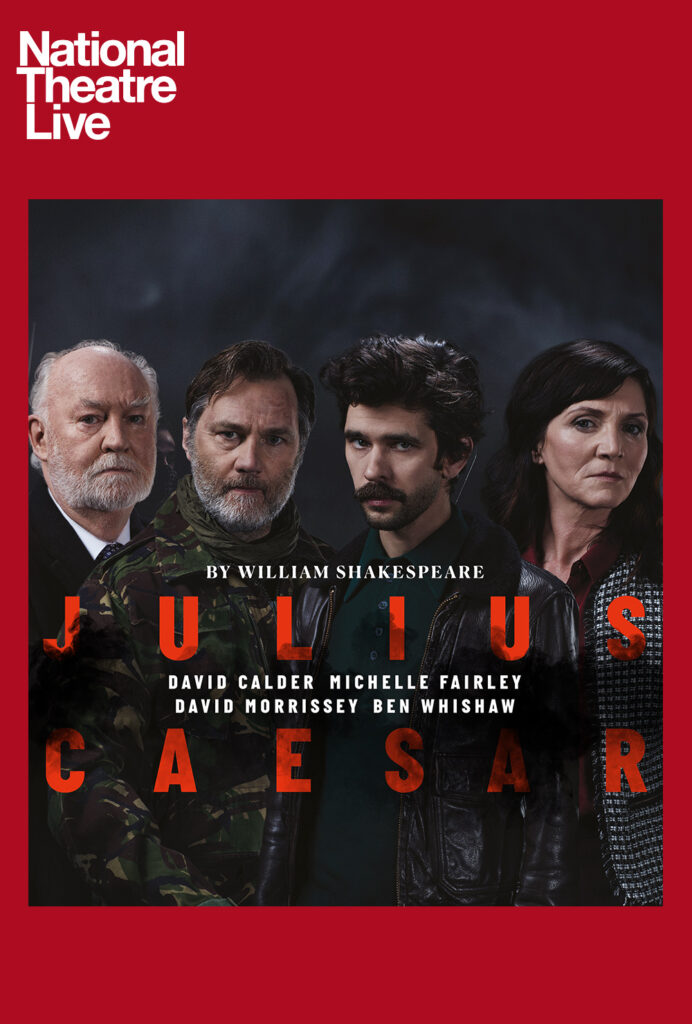
– National Theater live Julius Caesar 2018 with Ben Whishaw as Brutus
Recommended Analysis
– Épisode 1/4 : “Jules César” ou le désir impossible de pureté de l’acte politique – Radio France: https://www.radiofrance.fr/franceculture/podcasts/les-chemins-de-la-philosophie/jules-cesar-ou-le-desir-impossible-de-purete-de-l-acte-politique-8820324
– Shakespeare Julius Caesar explained – Tristan and the Classics: https://youtu.be/uooY3vw1aEo?si=SyK55S9h1lp95pYp
– Julius Caesar – Sparknotes: https://www.sparknotes.com/shakespeare/juliuscaesar/
– Julius Caesar (play) – Wikipedia: https://en.wikipedia.org/wiki/Julius_Caesar_(play)