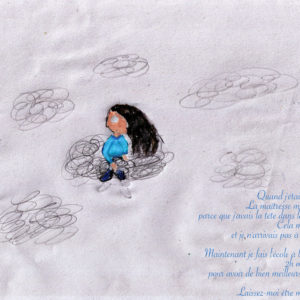
The number of pathologies affecting children has risen from 50 to 500.
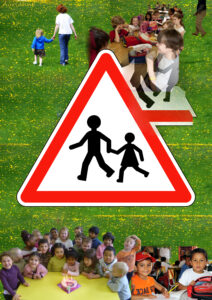
There are more and more children per class, fewer and fewer supervisors, fewer and fewer school nurses, school psychologists and social workers.
Epidemiological studies show that children have different diagnoses depending on their social background.
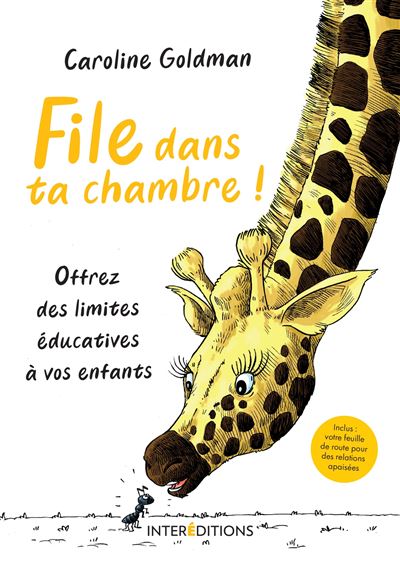
File dans ta chambre – Caroline Goldman
In low-income families, children will be categorized into neurotic personality types: type A person with a tidy life, B person who doesn’t tidy up a bit dreamy or C, etc. This has no scientific basis. Modest families don’t go to the specialists, and fall back on worthless personality tests on social networks, in magazines or in community centers. These tests were invented in the 70s as recruitment tests, and the fashion has stuck.
Laid back, unreliable, free-spirited: the ‘type B’ personality is having a moment – The Guardian: https://www.theguardian.com/wellness/2025/aug/15/type-b-personality-trend-tiktok
In middle-class families, children will be categorized according to pathologies: mild Asperger’s, pre-depression, student burn-out, etc. These families have access to both contracted and non-contracted doctors. They give priority to reimbursed professionals. These professionals generally prescribe SSRI-class drugs (antidepressants), and the diagnosis is in the group of anxiety disorders.
In high-income families, we find behavioral disorders that may or may not be associated with high intellectual potential: attention deficit hyperactivity disorder (ADHD). They have access to non-reimbursed professionals such as psychologists.
These diagnostic differences have given rise to dubious analyses of social determinism: children from affluent backgrounds are said to be more intelligent, while children from disadvantaged backgrounds have perverse, child-tyrant or neurotic personalities.
There are even age differences. Parents are only asked to consult because their child is younger, and therefore behaves or does less well than his or her classmates!
Effet de l’âge relatif sur l’initiation d’un traitement par méthylphénidate et sur le recours à l’orthophonie – Epi-phare: https://www.epi-phare.fr/rapports-detudes-et-publications/age-relatif-methylphenidate-orthophonie/
Do these children suffer? Most of the time, they don’t suffer. Adults, on the other hand, complain about their poor grades at school and their non-conformity.
The fact that children can no longer do what everyone else does is linked to other causes: children live further and further away from their schools (the average journey to school rose from 12 to 25 km between 2000 and 2020), there are fewer adults to look after them in schools, day-care centers and at home, some are fed sugar and ultra-processed foods and children hear their parents stressed by impoverishment and the fact that despite their studies, they can’t secure their careers.
It’s the environment that has changed.
It’s become so difficult to find a doctor who’s social security approved and available that personality tests, coaches, specialized schools and psychologists have developed, with results that are more or less convincing, but which enrich these salespeople.
Children simply have individual differences. Some are more athletic, others more dreamers. They have different desires and do different things.
Individual Differences – Robert Sapolsky- Stanford University: https://youtu.be/-PpDq1WUtAw?si=5Z2rMFs8ZzlV5Dac
Society is turning education into a technique: creating a class of workers with the least possible effort. The technocracy of education is killing education.
Épisode 2/5 : “Ce n’est pas la technique qui nous asservit mais le sacré transféré à la technique” – Radio France: https://www.radiofrance.fr/franceculture/podcasts/avoir-raison-avec/un-penseur-critique-ce-n-est-pas-la-technique-qui-nous-asservit-mais-le-sacre-transfere-a-la-technique-2215385
When consulting, the child’s education will be more successful because, in the end, the child will have an adult to look after him (coach, doctor, art therapy, horse-riding, etc.). But this is no longer the responsibility of society. Parents should not be sent to consult one pseudo-specialist after another. In all cases, listening to the child and making him draw is not enough. Ultimately, it costs more per child, but it’s not society that pays. The state is not fulfilling its role of providing equal opportunities or educating its population. We have to stop talking about statistics and figures.
What do we expect the State to do for its citizens? It’s no longer baccalaureate results, it’s no longer good Christians as in the past, it’s no longer good soldiers as at the end of the great wars, and so on. Since the 70s, schools have had no purpose. As a result, school will always be too expensive, because it no longer has a role to play in society. It teaches reading, arithmetic, general culture and basic behavior, but that’s all. It serves as a theme-based day-care center. The fact that it costs less and less is not an objective. Today, we’re unable to measure the school’s performance, to know whether it’s succeeding or not, because we don’t know what its objective is.
What do we want to do with our children? How can we manage their differences? What should schools be used for? A public debate is needed.
We have to stop using carrots and sticks, rewards and punishments, to make children conform to an ideal. We have to stop rejecting crooked carrots. Children make noise, run and jump around, can’t manage their emotions and hit. They’re not made to sit quietly all day. We need to teach them how to behave in society, not condemn them because they can’t doit yet. People who can’t stand children or who apologize for their children behaving like children should be singled out. Children need to be taught. Some teenagers have teenage rebellion. But they often rebel for perfectly valid reasons: they’re not listened to, they don’t make any decisions about their lives, they’re forced to do things they don’t want to do, they can’t talk to their friends to learn to socialize as their age demands, they can’t move around and make noise. Some are racketed, beaten, humiliated on the Internet, or have chewing gum put in their hair. They are locked into a school that accepts only one way of being. To prevent the increased risk-taking that is normal in adolescence from endangering them or others, and to reduce crime, they are not allowed to play in nature.
There are real pathologies that can be treated with medication and therapies by specialized psychiatrists. There is then a need for scientifically validated tests and therapies. But there aren’t as many sick children. It’s like allergies and gluten intolerance. We need to stop with personality tests and behavioral disorders. We need to help children who are suffering.
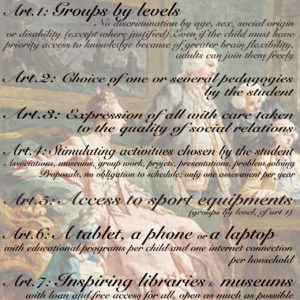
Children who suffers because their differences are not accepted have no pathologies. All they need is for adults to explain things to them, to spend time with them, to take the time to discuss what helps them to behave better and live with others, or to succeed in exercises, to warn them of what’s going to happen to them, to let them choose their activities, to let them say what they need and be given it (e.g. eating, sleeping, moving, etc.), make sure they agree to do what they’re asked to do by explaining the purpose of what they’re being taught or asked to do; don’t demand results like you would for a show monkey; give them time to show their progress when they want to. The question should be: What can we do to help them do this or that? Try out different reactions, methods and pedagogies, and ask the child afterwards what he prefers. For example, when he’s angry, try calming him down with a hug, leaving him alone in a corner, giving him a security blanket, etc., and ask him, once he’s calmed down, what works. Firmness in setting limits must be benevolent, and limits must be explained. Children need to be encouraged and congratulated when they succeed. They need to be given self-confidence in their abilities and made aware of their weaknesses, without this becoming a big deal. Children do their best, and punishment should be the exception rather than the rule. Children need to be taught to communicate their feelings so that they can live with others better. For example, they can be given cards to express themselves: green means I’m calm, orange means I’m in trouble but I’m managing, red means I’m out of control. Adults need to remain calm, attentive and responsive, respecting the different skills of each child. They have to take them seriously and not force them. It’s not that they don’t want to, they just can’t do it. Adults have to patiently repeat the same things over and over again. More adults per child are needed. Eventually, it pays off. It takes time and effort, and optimizing is not an option.
The environment is less and less tolerant for children, but this is also true for adults. There are adults in professional difficulty who are told that the problem lies with them. They are advised to consult a coach or an auditor, or to take training. There are late diagnoses. The problem is just that this person may not be needed anymore: he may have had a “bull-shit job”, he may have been replaced by a machine, his job may have been relocated, and so on. The prevailing attitude is to question the individual, whereas it’s society that’s changing: there’s less need to work. The discourse is just as toxic for the adult. It’s not their fault!
With the technician approach, personality type testing is automated: it’s the AI that make people take the test!
AI Snake Oil: What Artificial Intelligence Can Do, What It Can’t, and How to Tell the Difference – MIT Stone Center on Inequality & Shaping Work: https://youtu.be/C3TqcUEFR58?si=CngpppHMLDVj-sbH
Translated with Deepl