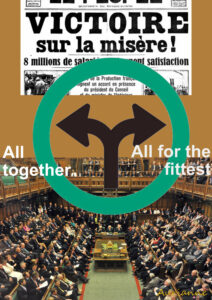
In modern democracies, the president is the head of the executive power. He or she is supposed to enforce the laws. He is not supposed to make decisions. He is supposed to be a technician who enforces the laws passed by parliament. He should be a civil servant. The fact that he is elected gives him a semblance of legitimacy to challenge the legislative body, to challenge the laws passed by the representatives of the people. He has the power to sign or not sign laws. For example, in France, Jacques Chirac decided not to sign the law recognizing osteopathy as a medical practice. As the system currently operates, the president has a role similar to that of a king. This does not correspond to the values of a democracy that gives power to the people.
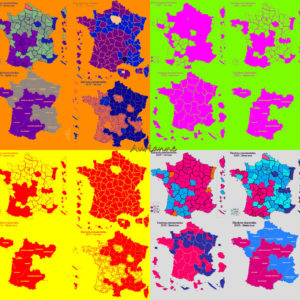
In France, the National Assembly is composed of 577 elected representatives who represent the territory, district by district. The same is true in other democracies, with a different number of representatives. They are supposed to represent the people.
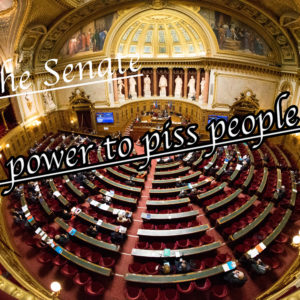
But the Senate, which is not elected by the people, has the power to overturn laws passed by Parliament. Senators are elected by city mayors, except in the United States, where they are elected by states. The principle of one person, one vote is effectively violated.
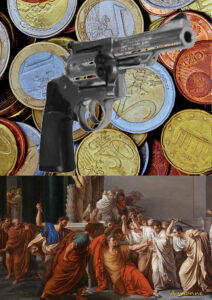
The election of representatives (president, deputies, mayors, etc.) poses several problems. Candidates for election seek personal power. They are mostly people who have the desire and the means to be elected. They do not represent the population, they represent people who fit this profile. They are not experts. They are no more competent than other citizens to make decisions. Some are more intelligent than others, and, depending on the subject, they are more or less competent. They campaign on a limited number of issues, which does not give an overall view of their future actions. Furthermore, they are not compelled to keep their promises. Once in power, it is possible to buy their votes, and they are often vulnerable to corruption. They are also influenced by polls because they are thinking about their re-election. Professional politicians will often make decisions based on their re-election prospects or the interests of those around them rather than the public interest, even if some would like to twist the idea that the particular interests of a multinational corporation will benefit the people and ultimately make them happy. Since they are elected by majority vote, minorities are never represented. Elected officials come from a party. When they vote in the National Assembly, they follow their party’s instructions. They do not vote according to their electorate but according to their party’s directives and they exclude suggestions from other parties; they function like clans. In reality, the political parties are the ones who govern the country.
The power of political parties must be taken away.
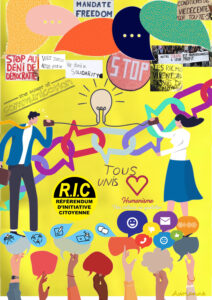
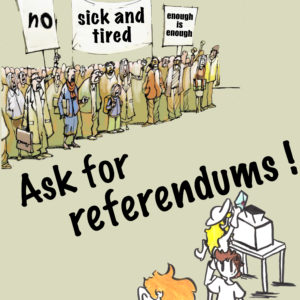
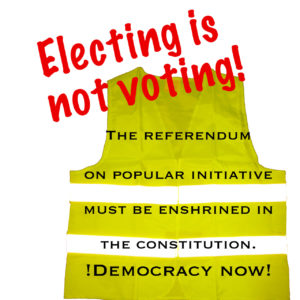
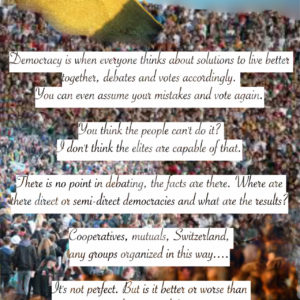
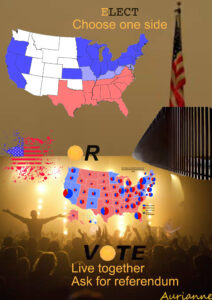
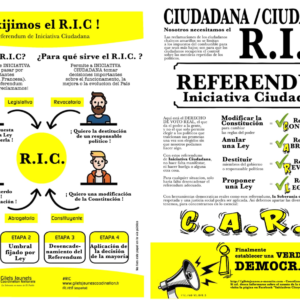
Referendums make democracy more direct. They could allow the people to truly decide their own fate. Elections do not reveal what citizens really think (tactical voting, voting based on promises, voting for the least worst option, etc.). Voting in a referendum reveals exactly what the people think. Referendum voting allows the people to place numerous limits on their representatives.
There are measures that can only be taken in conjunction with others, otherwise citizens will not get what they want. Referendums should allow people to vote on groups of measures. For example, if citizens vote for better animal welfare in livestock farming, they must also vote to control the prices or even ban imports of meat that do not meet these animal welfare criteria, otherwise there would be unfair competition. If the vote is only on animal welfare without price controls, citizens may vote against it to prevent farmers from going out of business, even though they are in favor of animal welfare measures.
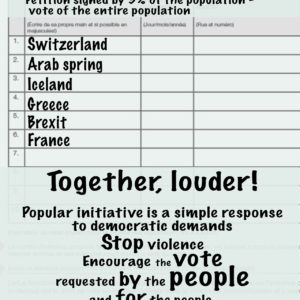
But referendums cannot be used to address all issues. They pose only one question, which can only be answered with a yes or a no. They do not allow for swift action and it is difficult to deal with subtle situations. In Switzerland, where it is widely used, by way of the popular initiative referendum, the population can often bring its elected representatives back into line. For example, by refusing to purchase fighter jets. But this does not prevent corruption. For example, there are road works and train works that are unnecessary (which is a subtle concept) and are financed by the population.
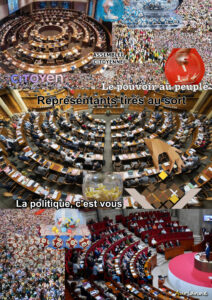
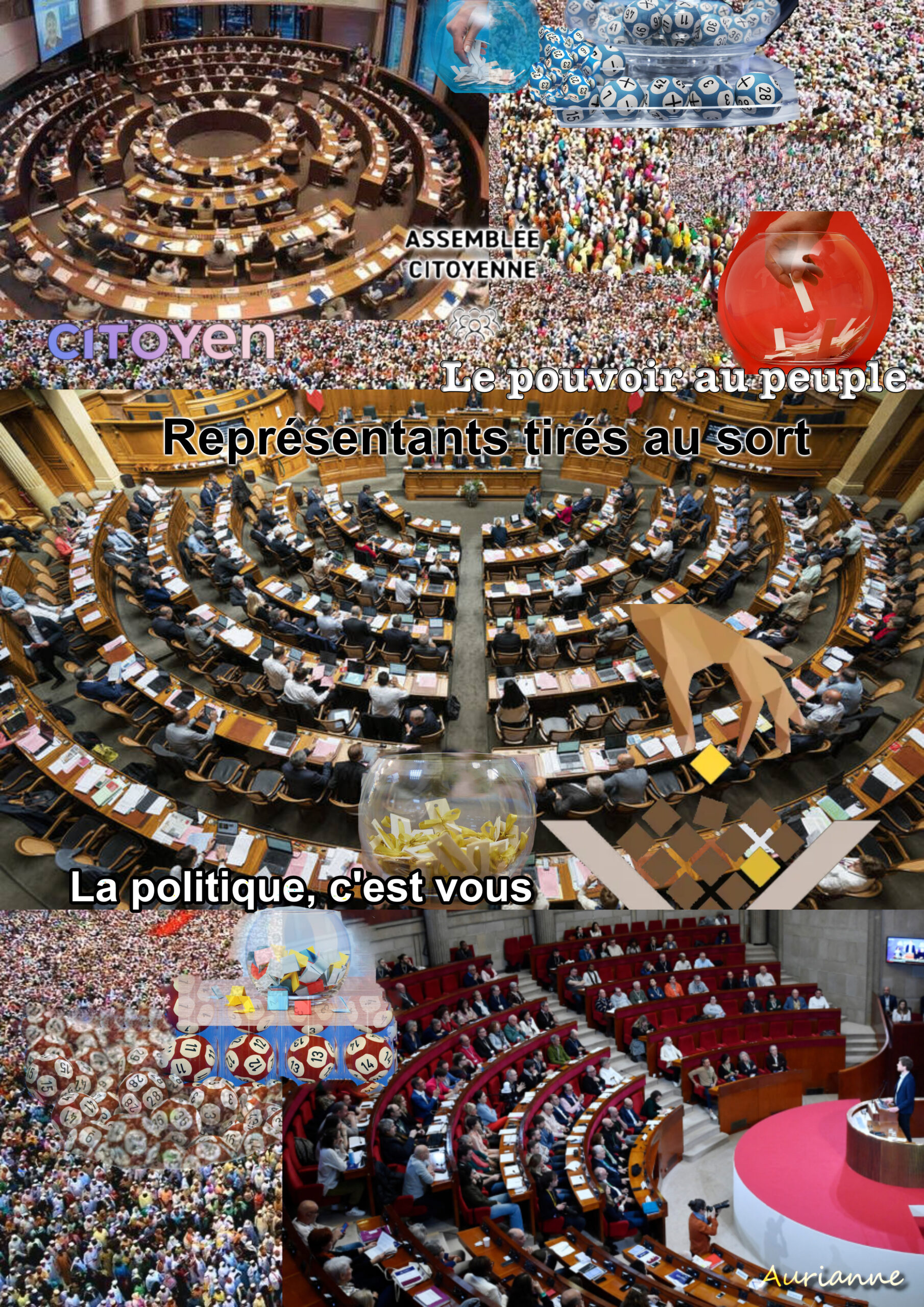
If representatives are chosen by random selection, they have no prospect of being re-elected and cannot pass on power to their children. Nor do they have any interest in following a political party. Parties can promote their ideas, but that is all. If representatives are corrupt, the justice system can intervene because they are not supported by a minister from their party who would declare a prosecutor’s dismissal.
It is possible to give them power for a short period of time, for example one year.
Between 400 and 500 people would need to be selected.
Cyril Dion’s experiment, in which 150 randomly selected people were invited to meet with experts to decide what needs to be done for the environment, shows that all citizens are capable of understanding the issues at stake if they are given the means to do so. These 150 people even did a better job than professional politicians, who are graduates of elite universities and in the pocket of the ultra-rich. These same professional politicians were quick to shelve most of the measures proposed by the 150.
Les 150 – des citoyens s’engagent après la convention citoyenne pour le climat | Documentaire LCP : https://youtu.be/qkIVH2Lr-sE?si=R5HuejIfNMaBjn3r
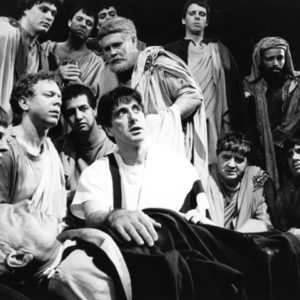
In Athens, the assembly of 500 representatives, called the magistracy, was chosen by random selection from among all citizens.
Petite histoire du tirage au sort en politique
D’Athènes à la Révolution française – Collège de France – La vie des idées: https://laviedesidees.fr/Petite-histoire-du-tirage-au-sort
“Le tirage au sort assure une représentativité plus importante que le vote” – Sciences Po: https://www.sciencespo.fr/fr/actualites/le-tirage-au-sort-assure-une-representativite-plus-importante-que-le-vote/
Judith Bernard : « Le tirage au sort rappelle à chacun qu’il est citoyen » – Revue Ballast: https://www.revue-ballast.fr/judith-bernard-tirage-sort-rappelle-a-chacun-quil-citoyen/
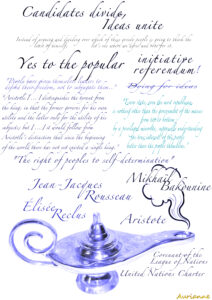
“The selection at random was the remedy for an evil that was both much more serious and much more likely than government by incompetents: government by a certain competence, that of men skilled in seizing power through intrigue. Since then, the selection at random has been the subject of a tremendous effort to consign it to oblivion.”
Le tirage au sort au XXIe siècle. Actualité de l’expérimentation démocratique – Cairn Info: https://shs.cairn.info/revue-participations-2019-1-page-5?lang=fr
1789 : les révolutionnaires défendaient-ils vraiment la démocratie ? – France Culture: https://www.radiofrance.fr/franceculture/podcasts/questions-du-soir-l-idee/1789-les-revolutionnaires-defendaient-ils-vraiment-la-democratie-1425270
Renaud – Le tango des élus (Audio officiel): https://youtu.be/q5bLdVJ86TE?si=F2QP_WjfGJUUUkzn
Of course, there must also be the means to enforce the laws passed by the people (independent prosecutors, police, military, labor inspectors, etc.).
Translated with DeepL