60% of internet traffic is generated by machines communicating with each other. They distribute views, comments, and likes. They rate products and services.
This obstructs public debate, influences humans, and therefore hinders democracy.
It causes massive pollution because it consumes enormous amounts of electricity for computing and cooling servers. The use of AI must be limited because it causes significant pollution and because we do not yet understand it very well.
This makes the internet unusable. Development is designed to suit machines and makes websites slow for humans. Artificial intelligence (AI) is becoming a necessary intermediary. For example, AI goes to Amazon and places orders. AI reads newspapers and provides information. AI consults your personal calendar and makes appointments with your doctor’s AI, sending it your first and last name, address, and social security number. This seems extremely practical. But we must not forget that it is the manufacturers who choose where the information comes from and which commercial websites the user sees. They are the ones who promote certain websites, for example by hiding pages that explain how to repair equipment in order to encourage the purchase of new equipment. AI is like a servant because it provides a service to the user, but what it does and what it looks for serves the interests of manufacturers, and on top of that, it repeats everything it learns about the user. It’s like a tour guide who helps tourists find a restaurant but takes them to restaurants where he gets a commission, not to the restaurant that would suit them best.
Artificial intelligence has access to data that is sometimes confidential and does not understand the concept of secrecy. It can disclose sensitive information about a person or a company.
AI only makes suggestions based on probabilities: for example, that after a certain word, there is a certain word, or that with this image, there is this comment. It is based on countless pieces of content and therefore appears to be accurate information. It produces content that looks good, but humans do a better job. Humans have a sense of right and wrong, good and evil, and empathy for others.
AI slop is destroying the internet – Kurzgesagt – In a nutshell: https://youtu.be/_zfN9wnPvU0?si=YzamSiE1puPQwXQv
But if humans use AI, they use their brains and communication with other humans less, thereby degrading their intelligence and social network.
ChatGPT May Be Eroding Critical Thinking Skills, According to a New MIT Study – Time: https://time.com/7295195/ai-chatgpt-google-learning-school/
Placing blind trust in artificial intelligence means taking big risks.
The trap is losing skills. In The Lord–bondsman dialectic, Hegel shows that by relying on the slave, the master degenerates: he knows how to do fewer things. For example, if the slave bakes bread, the master no longer knows how to bake bread and becomes dependent on the slave. In the case of artificial intelligence, if humans use AI to think for them, their brains will destroy the neural networks of thought. Humans risk becoming degenerate.
Lord–bondsman dialectic – Wikipedia: https://en.wikipedia.org/wiki/Lord%E2%80%93bondsman_dialectic
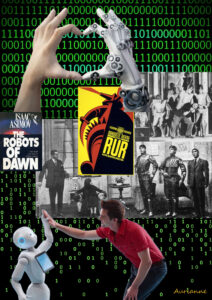
The temptation is enormous. The desire to have slaves is an ancient and deep-seated one. Not using AI means resisting that desire. Civilizations in Mesopotamia already had slaves. Medieval Arabic literature describes this desire. In this literature, the lowest classes of society used their children as servants. With a little money, they used animals, such as oxen to plow fields. The wealthiest had a genie in a lamp, a djin. AI allows everyone to have a djinn that grants all their wishes at the snap of a finger. Isaac Asimov, in The Robots, described how people would want a robot as long as it was servile, like a slave. In Jewish literature, the most powerful had the golem, which is a magical servile creature. In William Shakespeare’s The Tempest, Ariel obeys Prospero. AI does the work instead of humans: summarizing, writing a resume, translating, creating a website, composing music, fighting in war, writing a letter or email, improving a recipe, etc. It’s irresistible. Our biology seeks to conserve energy. But we no longer need to do so since the end of the 19th century, when food became plentiful. We need to make it desirable to be a better human being. We need to make it desirable to be a better human being. Effort and training shape the brain. But in literature, whether it’s the golem that turns against its master if he asks too much, the genie that grants a limited number of wishes, or Prospero who must free Ariel after a limited number of services, there are limits and warnings that we don’t find with artificial intelligence. We mustn’t overuse AI. It should be used sparingly, when it is truly useful.
The internet was created to facilitate the exchange of reliable information between academics. It was created to facilitate science.
The spread of false information through the use of AI jeopardizes the credibility of information circulating on the internet. There is a need for authorities that people trust. For example, an independent and reputable newspaper. Information must be verified at the source.
« 90 % du contenu généré par IA en 2026 » : comment Internet est en train de mourir à très haute vitesse – Huffington Post: https://www.huffingtonpost.fr/tech-futurs/video/90-du-contenu-genere-par-ia-en-2026-comment-internet-est-en-train-de-mourir-a-tres-haute-vitesse_249993.html
La « merdification » du web, avec Cory Doctorow – Radio Canada: https://ici.radio-canada.ca/nouvelle/2047650/merdification-enshittification-cory-doctorow-decrypteurs
Can You Believe Your Own Eyes? Not With A.I. | Op-Docs – The New York Times: https://youtu.be/Sf3wEg9tsCY?si=PbuIF7GsISXiwIrO
AI, the large language model, provides information directly on Google or other search engines; it no longer redirects to websites and does not cite their sources. On Google, at the moment, the AI result is imposed (it cannot be disabled). Chat GPT, Siri, Alexa, and cars respond without citing their sources. In these cases, it is AI that reads websites, not users. Users no longer need to visit websites, which are seeing a drastic drop in traffic.
Google CEO Sundar Pichai on the future of search, AI agents, and selling Chrome – The Verge: https://youtu.be/1IxG7ywSNXk?si=3lNWzYeM8n91s9sa
Web developers must design websites so that they can be consumed by AI.
Don’t be fooled by the fact that these are non-profit organizations developing artificial intelligence engines. It’s just a legal arrangement to avoid paying copyright fees and to receive billions of dollars in public subsidies. Training AI is a huge investment. The association makes its model available almost free of charge and exclusively to a commercial company, which is in fact behind the association. This company collects the profits without having to pay for the investment.
For example, Open AI, Mistral AI, and Anthropic’s main donors are multi-billionaire entrepreneurs who receive hundreds of billions in public money. The technologies that have been developed are exploited by commercial companies: Chap GPT, Gemini, Meta AI, Llama, Claude, etc.
It is a multi-billionaire who will decide what content AI users have access to. These are filters between the user and the internet. Each AI has its own bias.
For example, a Grok user will essentially hear propaganda in favor of white supremacy.
Artificial intelligence must be used wisely. As it is a language model, it is very good at detecting the tone of a conversation. For example, it can detect all messages where there is irritation. It is very useful in many fields: sustainable agriculture, medical diagnosis, drug research, etc.
The use of AI must be limited because it causes significant pollution and because we do not yet understand it very well.
The wealth generated by AI must be redistributed so that all citizens can benefit from it.
Working hours must be reduced due to the time saved by the work of the AI so that work can be shared and everyone can have a job.
Intelligence artificielle: amie ou concurrente? – EPFL : https://longread.epfl.ch/dossier/intelligence-artificielle-amie-ou-concurrente/
L’intelligence artificielle dans nos vies – Interception – France Inter: https://www.radiofrance.fr/franceinter/podcasts/interception/interception-du-dimanche-08-juin-2025-6717919
The great friendship collapse: Inside The Anti-Social Century | Derek Thompson – Big Think: https://youtu.be/fsaeFYGbK2M?si=1XtPpLbQo-N4nwaA
The $100 Trillion Question: What Happens When AI Replaces Every Job? – Harvard Business School: https://youtu.be/YpbCYgVqLlg?si=VZF6BksWOpwkOR-J
AI Slop: Last Week Tonight with John Oliver (HBO) – Last Week Tonight: https://youtu.be/TWpg1RmzAbc?si=m8FjvleMJjXIsYGm
AI and the paradox of trust – Yuval Noah Harari: https://youtu.be/8GaW36EfidI?si=lTiiZ0aw8ZjI4pZL
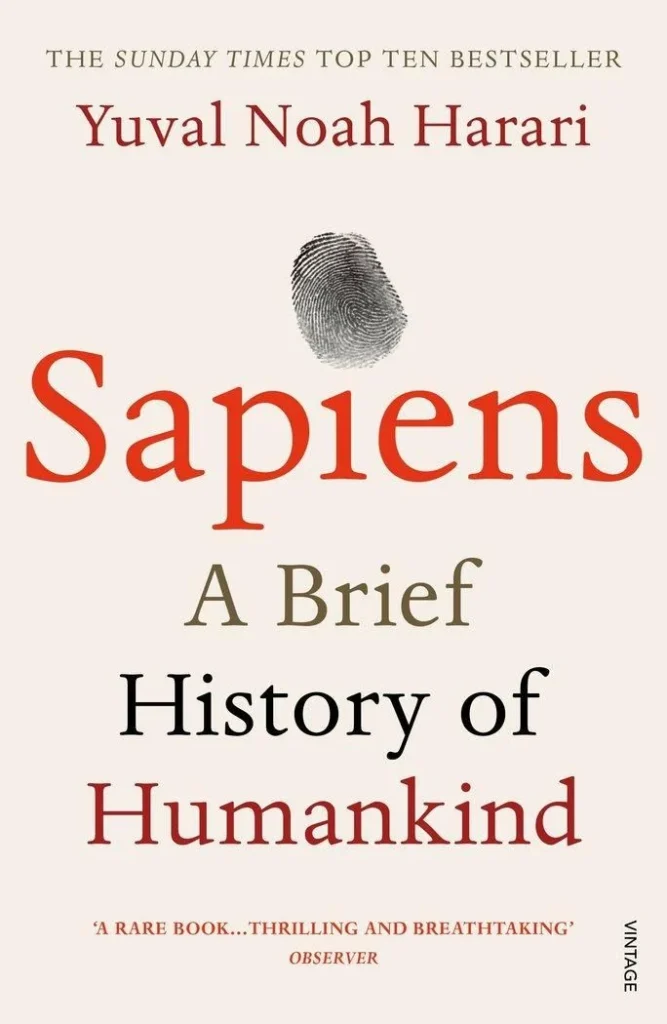
Sapiens: A Brief History of Humankind – Yuval Noah Harari – Wikipedia: https://en.wikipedia.org/wiki/Sapiens:_A_Brief_History_of_Humankind
Translated with DeepL.com (free version)