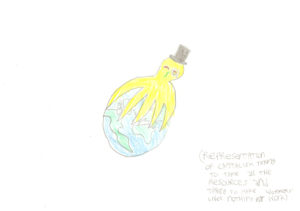
Karl Marx demonstrated that capitalism would experience numerous crises due to its inherently unstable functioning, which penalizes the majority of the population. Companies cannot differentiate themselves from one another solely through their machinery, because their competitors also have machinery that they can push to its limits. Human labor can always be pushed to do more and work longer hours. This is the source of profit in capitalism. There always comes a time when this workforce collapses because it works too hard and is not paid enough. It becomes demotivated and falls ill. It no longer has enough resources to consume. It may then revolt. This is when crises occur. Workers – who have been paid very little – find themselves in difficulty, while the rich have been able to save and can use their savings to live well even during crises. After the crisis, after the chaos has been created, order must be restored.
A tyrant is chosen by the people who fear chaos. The state intervenes to revive industry. It invests, for example by ordering weapons. Wages are increased and the cycle begins again.
Neoliberal economists accepted Marx’s thesis and sought to space out and mitigate these crises. For neoliberals, companies must be as free as possible in their decisions, but public money must be spent to help them when they are in difficulty. According to them, prosperity cascades down from healthy companies to the rest of the population. The jobs created allow employees to spend money on goods and services (daycare, restaurants, shops, subcontractors, etc.). The well-being of the company sustains everyone. The crises of the 1920s and 1930s plunged the population into poverty and destitution. There was no social security. Neoliberals have helped to avoid the kind of terrible crises of the 1920s and 1930s. However, there were still crises in the mid-1970s until the early 2000s. The welfare state helps the population, but above all it helps businesses.
It is important to note that from 1945 to 1975, the Western world experienced the Trente Glorieuses (Thirty Glorious Years) thanks to a social democratic state, without a welfare state but which set rules and provided protection through social security and unemployment benefits. They did not spend money on subsidies to private companies, and there were no crises either. The model of the Glorious Thirty is clearly better than the neoliberal model.
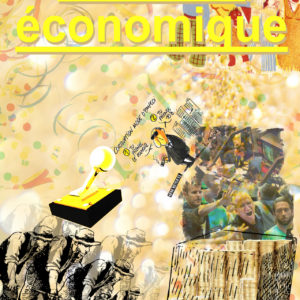
How is neoliberalism financed? Aid to businesses is financed directly by taxes, and therefore by taxpayers. For example, when grain prices are low, farmers receive aid, which allows wholesalers to buy grain cheaply. Aid to businesses is also financed by debt: the state borrows money from the country’s wealthy citizens.
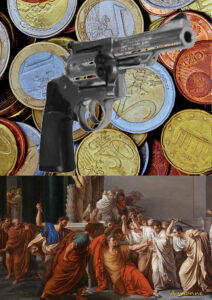
In France, Louis XVI also borrowed money from his citizens. In 1786, the middle classes who held bonds believed that the state would not repay them because it was so poorly managed. This marked the beginning of the French Revolution: a wealthy and educated class began to worry and wanted to take a more active part in state decisions. In response to this wealthy and educated population, Louis XVI summoned the Etats Généraux because he wanted to borrow more money. This exposed the fact that the state was unfair and ill-adapted (chivalry) and that it was not at all modern. Why finance the nobility? Why finance the church? Why protect the triangular trade? Who benefits from this? The questions raised by this population meant that the entire population began to see clearly that they were being abused, that they were the victims of a farce. They were the ones who worked, who paid taxes, and who received almost nothing in return. Enlightened by this Third Estate, they had had enough, and this led to the year 1789. The people overthrew the old regime. Ten years of chaos ensued: there were acts of violence, the country was not governed, the population was left to fend for itself, neighboring countries declared war on France, and then there was the Reign of Terror. Ultimately, in order to restore security, order, and prosperity, Napoleon came to power and, with popular support, reinstated a regime very similar to the Ancien Régime.
Now, all the world’s elites fear that such an event could happen again. The lesson learned by the elites, particularly Chateaubriand, a nobleman who lost his entire family to the guillotine, is that it is possible to oppress the common people without them rebelling, but that one must never push the middle class too far, as they are capable of exposing the lies of the state.
The middle class sought to reform the state. The situation got out of hand and degenerated. Moreover, it did not propose an alternative way of functioning. It did not make any proposals for society. It brilliantly exposed the weaknesses of their present but was unable to propose a different future.
In the 19th century, China experienced one of the bloodiest conflicts in human history, with 20 to 30 million deaths: the Taiping Rebellion. The people denounced the lack of justice and inequality. The rebellion brought down the Qing dynasty. But after the conflict, in order to restore order, the population turned to Westernization, just as the Qing had done. There was no change because there was no alternative model.
In 1989, the Soviets brought down the Soviet Union by denouncing the military dictatorship that was incapable of feeding its population. This was followed by ten years of chaos, a lawless society ruled by gangsters. In the end, the population turned to a former KGB agent, the symbol of oppression and Soviet political policing. With no real alternative model, the Russians returned to the previous political regime because they preferred it to disorder: a military dictatorship with political policing.
Destruction is not enough; it is necessary to be able to rebuild after the chaos: schools, administration, businesses, etc. An alternative must be planned in advance, otherwise revolts will not bring about change. Chaos and violence are detrimental to change.
Nowadays, citizens pay their savings back to the richest through their taxes. They have no choice.
For example, housing assistance, financed by taxpayers, is given to tenants, who then spend it on their landlords, who can then raise the rent. For example, through subsidies and streaming TV subscriptions, film producers will be paid regardless of whether the film is popular or not. For example, through subsidized jobs (for young people, seniors, people with disabilities, apprenticeships, etc.), employers do not pay the full salary; taxes finance these subsidies, which allows companies to have lower costs and therefore make more profits. For example, energy vouchers, consumer vouchers, or restaurant vouchers: the government gives money to citizens, but this money must be spent quickly and therefore paid back to, among others, oil companies, restaurants, supermarkets, and retailers. They can then raise their prices if they wish. For example, the renovation bonus, which is given by the state to individuals, allows the construction sector to prosper. The money simply passes through citizens; it is money from taxes that goes into the pockets of companies.
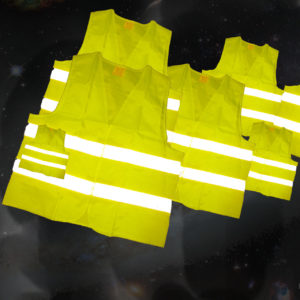
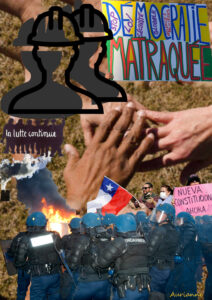
The alleged authors of L’insurrection qui vient (The Coming Insurrection) were imprisoned in France under false pretexts, but in reality because of their book. It refers to a growing discontent among the population, despite police pressure which aimed at maintaining the status quo at all costs. Indeed, in France, the yellow vests have been violently repressed. Power is maintained by force. It could change its attitude and listen to its people.
Closing hospitals, reducing the quality of education and therefore equal opportunities, unemployment, reducing pensions, not reevaluating the minimum wage, a slow justice system, the elimination of services in rural areas, police officers under stress; all of this means a lot of suffering.
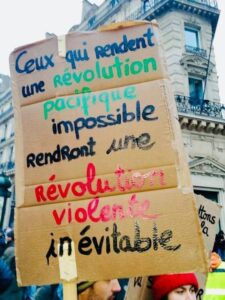
The current situation resembles that described in L’insurrection qui vient. It is a pre-revolutionary situation, as we have seen throughout history: economic and democratic tensions are causing the middle classes to become extremely dissatisfied. This is a common feature of the revolutions mentioned above. Those currently in power are well aware of this risk.
Qu’apprendre des contextes prérévolutionnaires ? Discussion avec Robert Darnton – France Culture: https://www.radiofrance.fr/franceculture/podcasts/questions-du-soir-l-idee/qu-apprendre-des-contextes-prerevolutionnaires-discussion-avec-robert-darnton-8083685
From an economic point of view, the middle classes, even those with degrees, find themselves in a state of financial insecurity: graduating from a prestigious business school no longer guarantees a well-paid job, and even incomes above the national average do not allow people to find sanitary and sufficiently large housing close to their sources of income. Despite some savings and inheritances, their money is not secure because bonds are devalued. Money is no longer secure; it can be lost. The state can default, as was the case under Louis XVI.
Pourquoi les diplômés universitaires n’arrivent-ils plus à trouver un job? – Blick: https://www.blick.ch/fr/fr/suisse/suisse-apres-luni-presque-impossible-de-trouver-un-job-id21295236.html?utm_medium=social&utm_campaign=share-button&utm_source=copy-link
The middle class no longer trusts the state and wants to be more involved in its decisions. In practice, it has no means of participating in decisions and is growing impatient.
This educated class uses modern means of communication to effectively denounce and explain the dysfunction of the state: the internet, strikes, word of mouth, etc. These middle classes may seek work abroad, thereby depriving their country of expertise. They may decide to stop saving, thereby depriving the state of funding for its welfare system. The middle classes may decide to consume through alternative networks: Amap, direct sales, creation and purchases in cooperatives, cycling instead of buying a new car, not buying a bigger house, not borrowing money. They look for ways to avoid paying taxes because they believe that the state does not involve citizens in decision-making: tax optimization by hiring a lawyer, advice on the internet, undeclared work, cheating on tax statements, etc. As the American revolutionaries said: “No taxation without representation.”
This means that the government will collect less taxes and will be able to borrow less. The result of this suffocation will be fewer public services and a great deal of economic hardship for the population. They will no longer receive assistance, civil service jobs will be cut, they will be less secure, they will be in poorer health, etc. This period must be as short as possible.
L’Insurrection qui vient – « Comité invisible » – La Fabrique: https://lafabrique.fr/wp-content/uploads/2017/05/pdf_Insurrection.pdf
But before destroying, people must agree on what they want to build. They must learn from previous revolutions in order to avoid violence and a return to the original situation. They must avoid a vacuum.
They must build a realistic alternative with an economic and democratic model that is desirable for all citizens and capable of providing security and prosperity for all in a short period of time.
The key is to make people want a new system.
In economics,
we need a protective state that sets and enforces standards and limits with price controls to ensure a decent standard of living for its citizens.
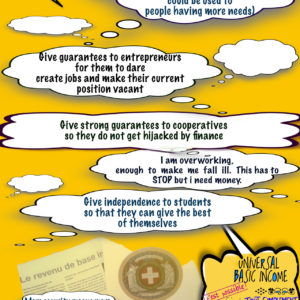
we need a universal basic income.
we need effective social security.
cooperatives and mutual societies must be promoted.
there must be a civil service with the resources to carry out its missions: defense, health, education, infrastructure (energy, roads, water, etc.), etc.
there must be 100% taxation of capital over €100 million.
In politics,
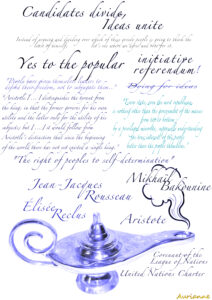
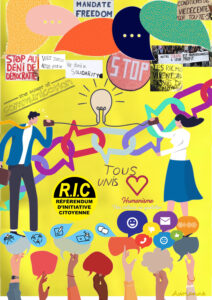
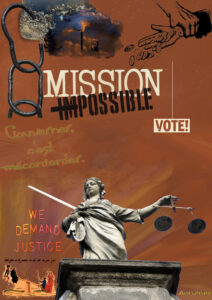
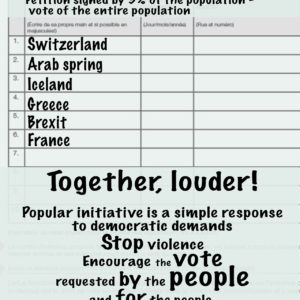
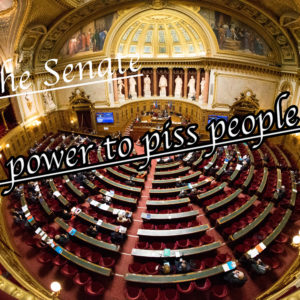
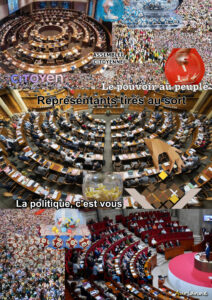
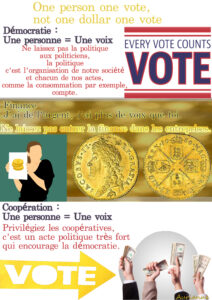
we need a more direct democracy: citizen-initiated referendums, a national assembly with representatives chosen at random, the abolition of the Senate, and elected prosecutors.
we need a powerful and independent police force and an independant judiciary system.
we need a constitutional council composed of magistrates who are judges and not former politicians.
we need an executive branch, a president, chosen by parliament from among the best civil servants.
From an ecological perspective,
individuals and multinational corporations responsible for ecocide must be prosecuted at the international level.
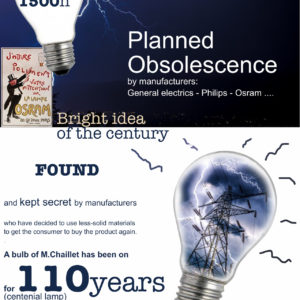
poor-quality products and products with planned obsolescence must be banned.
standards should not be changed too often and should only be established for the sake of the environment and safety.
developing countries must be helped to equip themselves in an environmentally friendly manner.
fossil fuel mining, nuclear power, and industrial activity must be restricted and limited in order to protect the environment.
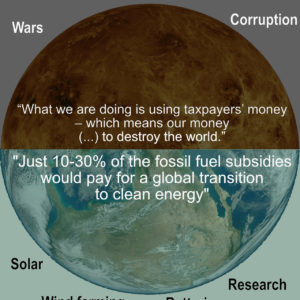
subsidies to companies that destroy the planet must be stopped.
The ruling power can borrow from these recipes and remain in power. A revolution is not necessary if the ruling power does not remain deaf to the demands of the people.
The police and army could allow citizens to express themselves and protest peacefully. They must stick to protecting people and property, regardless of their political affiliations.
Change can happen without violence. The more the government listens to its people and puts a plan in place for the future, the less risk there will be of disorder, rebellion, violence, or even insurrection or revolution.
Translated with DeepL