From the age of 10 to 15, I attended circus school on Wednesdays during the school year.
We could choose which activity we wanted to do. The choice depended on which teachers were there.
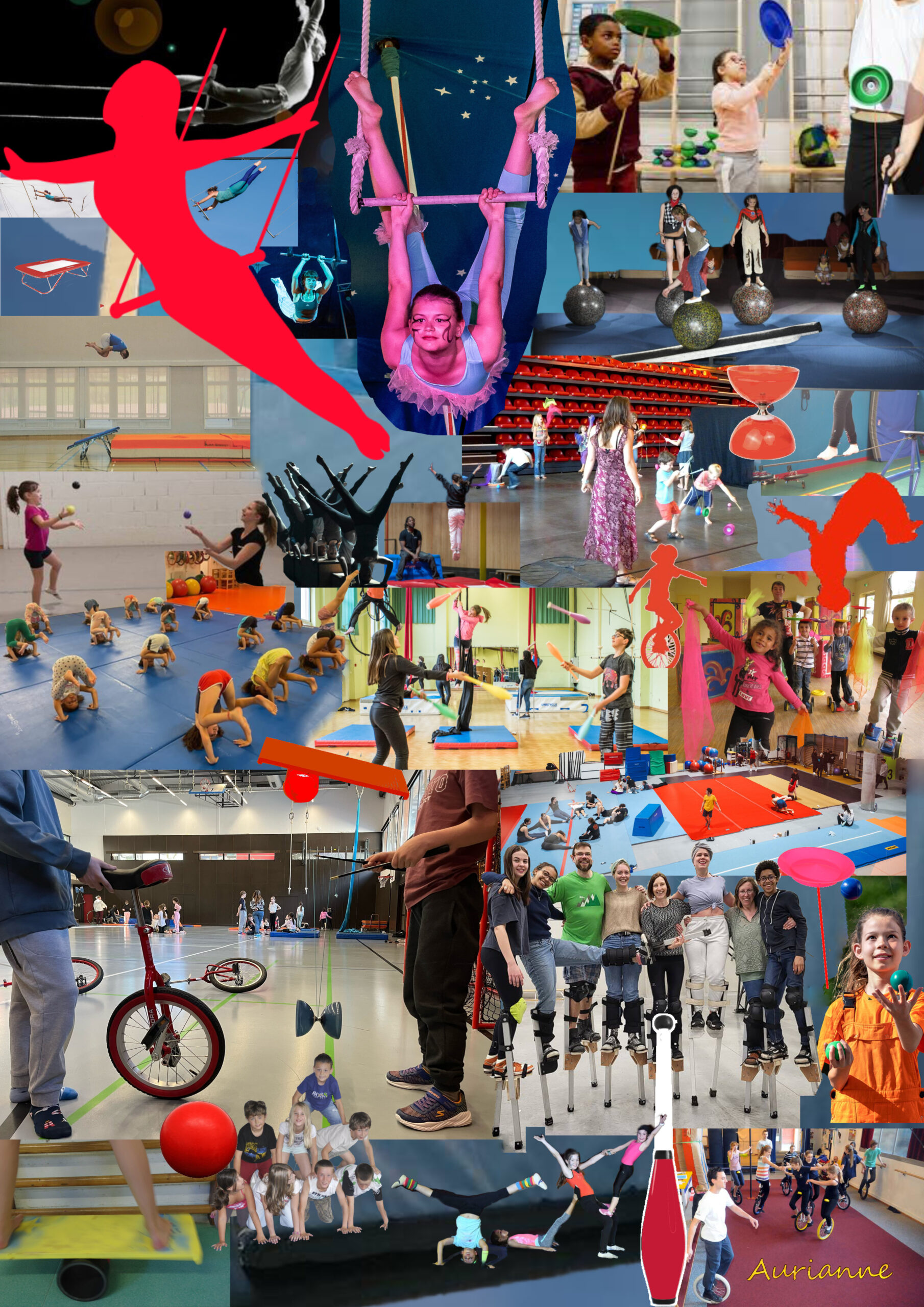
I started with balancing acts and walking on the globe and practicing rolla-bolla or diabolo or spinning plastic plates.
I particularly enjoyed the fixed trapeze, but especially the flying trapeze. At first, it was hard on my hands, despite the powder. Eventually, the skin on my hands toughened up and it was fine. At first, I was secured by a belt. But after four years, I was able to perform the flying trapeze without ropes. In the end, I even tried acrobatic trapeze: for example, pretending to fall but actually catching myself on the pole. Once, during a show, I was on the static trapeze. During one acrobatic move, I locked my feet in the rope and let myself slide down, grabbing onto the bar. My mother screamed because she thought I was falling! But nothing happened, everything was under control. It built up my muscles so much and without any effort, just having fun, that when we were offered the chance to go climbing at school, my middle school sports teacher put me in the most difficult group, where apart from me, there were only boys.
I also enjoyed juggling. Because I could not coordinate well, I wasn’t very good at it. But no one ever pressured me. The teacher would patiently explain the technique to me and let me practice at my own pace. I could see that the other children were more skilled than me. Some of the beginners were better than me, who had been practicing for a long time. But no one pointed it out. After four years, I finally managed to juggle three balls well, with some irregularity with four. I could also juggle three clubs. These exercises certainly played an important role in improving my coordination. When I was younger, I couldn’t catch a ball.
As for acrobatics, it was difficult for me. You have to be able to do a handstand, a cartwheel, and a bridge before you can start doing the other moves, and I never managed to do them. But again, no one pressured me. I only went when I wanted to, and the teacher would offer me exercises that were at my level. Since I was doing a lot of trapeze, and I ended it by spinning and landing perfectly on my feet, the teacher suggested I try an air somersaults. And I was really good at those. I would jump on the trampoline, go high up, do a full rotation, and land straight and steady on both feet. I also did acrobatic stand stills with other students.
Sometimes there were teachers who only stayed for a few months. They would lived in roulottes or caravans on a piece of land slightly lower than the school. We could then have a go at riding a unicycle, walking on stilts, or forming a human pyramid.
I was really keen on the clown workshop. We mimed animals and played pranks.
But what really made it a school of life was that everyone was accepted for who they were. Everyone contributed based on what they knew and wanted to do. My favorite teacher, the trapeze teacher, was a dwarf, and we saw all sorts of people with all sorts of looks. My friend was super astonished when I greeted a skinhead on the street, who was my stilt teacher and who was adorable.
There was no pressure for the shows. The teachers would find acts based on what we knew how to do. If we messed up on the day, no problem, we could just start over, maybe with a joke.
One year, when I had been absent a lot, I didn’t have a trick to perform. My teachers naturally suggested that I play the role of a mime: between each trick, I mimed a photographer taking pictures of the show.
As my mother always came to pick me up an hour or two late, while waiting for her, to pass the time during the next class, I practiced walking on a tightrope (which was only 50 cm above the ground). After three years, I was able to perform a tightrope act (still 50 cm above the ground) juggling with three handkerchiefs. As for my mother, she had given up and no longer came to pick me up altogether. Every week, I had to find a fellow student whose parents agreed to drive me back to town. I usually traveled in the trunk of the car. I would finish the journey running to the music conservatory and straight to my transverse flute lesson.
This experience demonstrates several things. There is no need to force children to learn. It is important to let them have the time they need to learn. Until they have mastered the basics, there is no point in moving on to the next stage. It is better to give small pieces of advice adapted to each individual’s level and let them train on their own, independently. It is important to respect the tastes and abilities of each person. If they don’t know how to do something, it’s okay; they can practice or focus on what they do know. It is also important to offer activities that build on what they already know. If you make a mistake, it’s not a problem, you can just try again.
Tolerance is the greatest gift.
Translated with DeepL and Ollama TranslateGemma