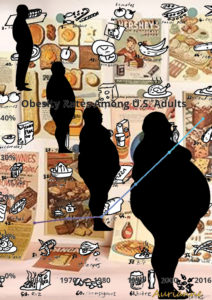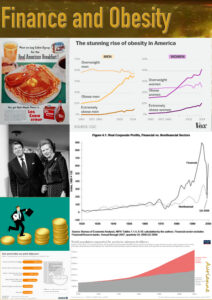
Processed food has historically helped human beings to be healthier (eg pasteurization, fermentation, natural conservatives, and so on). But ultra-processed food has not. It is proved that it causes diabetes, cancers, cardiovascular diseases, depression, mood disorders and obesity. So why does it represent more than half of the diet of the British and the Americans and why is it selling so well in developing countries?
This article explains that view in details: How ultra-processed food took over your shopping basket – The Guardian: https://www.theguardian.com/food/2020/feb/13/how-ultra-processed-food-took-over-your-shopping-basket-brazil-carlos-monteiro
The university of Cambridge and the UN have elaborated a classification called the Nova system to help buyers to know how processed is the food and make better choices.
To know more about the Nova system, click here: The UN Decade of Nutrition, the NOVA food classification and the trouble with ultra-processing – Cambridge University press: https://www.cambridge.org/core/journals/public-health-nutrition/article/un-decade-of-nutrition-the-nova-food-classification-and-the-trouble-with-ultraprocessing/2A9776922A28F8F757BDA32C3266AC2A
But this is not enough. Ultra-processed food doesn’t always even look like food but its attraction remains. Why? They are convenient, cheaper, they have stronger flavours and smell, and they release a first taste which doesn’t go on and make you want more to experience again. Moreover, advertisement and nostalgia due to the fact that people ate it during their childhood weighs more on the decision than a future health well being even if people may feel depressed afterwards because they did not have the willpower to resist that temptation.
For more details about this mechanism, read this. We know highly processed food is bad for us. Why do we keep eating it? – Global News: https://globalnews.ca/news/5331125/ultra-processed-food-nutrition/
To know more about willpower, read Willpower by Roy Baumeister, 2011.
To have a comprehensive understanding of human behaviour, read Behave by Robert Sapolsky, 2017.
So how to stop?
1. Stop watching advertisement and TV.
2. Shop after having eaten to give your prefrontal cortex enough energy to make the good choice.
3. Stop blaming yourself and lower your self-confidence because the food industry knows how to mess with your brain (colours, sounds, TV, flavours, packaging, and so on).
This article about the book Thinking, Fast and Slow by Nobel price Daniel Kahneman explains how our thinking is biased and how it can be manipulated by industry – Wikipedia: https://en.wikipedia.org/wiki/Thinking,_Fast_and_Slow
4. Shop online and take your time to read the labels and get information on the internet. The choice is made when you buy, not when you eat.
These websites give you a tool to know more about what you eat: Open Food Facts: https://world.openfoodfacts.org and the independent app Yuka: https://yuka.io
5. Be patient. This is an addiction, you’ll be craving even more for this ultra-processed food when you begin to stop. Later, you won’t miss it.
6. Cook, it’s not that difficult if you choose delicious and easy recipes.
7. Don’t avoid all processed food, as nature is not always that good for you. Avoid ultra-processed food only.
Aliments ultra-transformés, mais que mange-t-on ! ABE-RTS: https://youtu.be/YoemtsZ4Tvc
Ultraprocessed foods linked to heart disease, diabetes, mental disorders and early death, study finds – CNN: https://edition.cnn.com/2024/02/28/health/ultraprocessed-food-health-risks-study-wellness/index.html
San Francisco sues food giants over ultra-processed products – The Guardian: https://www.theguardian.com/society/2025/dec/02/ultra-processed-foods-lawsuit-san-francisco
The French have an increasingly negative image of ultra-processed foods and would buy less of them if they could identify them more easily. Furthermore, the results of the studies below show that people use the degree of processing as an indicator to assess the safety of food products. Attitudes are changing, while the French government is rushing to the aid of manufacturers. But if manufacturers are turning to the government, it’s because there has been a real change in attitudes and they are concerned that more and more well-informed people are turning away from ultra-processed foods.
Malbouffe : le gouvernement efface la limitation des “produits ultra-transformés” de la stratégie alimentaire nationale – France Info: https://www.franceinfo.fr/sante/alimentation/enquete-malbouffe-le-gouvernement-efface-la-limitation-des-produits-ultra-transformes-de-la-strategie-alimentaire-nationale_7643846.html
Ultra-processed foods are of poor nutritional quality in French consumers’ representations; a categorization study of images of food products without information – ScienceDirect: https://www.sciencedirect.com/science/article/pii/S0950329325001843?dgcid=rss_sd_all
Perceived degree of food processing as a cue for perceived healthiness: The NOVA system mirrors consumers’ perceptions – ScienceDirect: https://www.sciencedirect.com/science/article/pii/S0950329323001386?via%3Dihubhttps://www.sciencedirect.com/science/article/pii/S0950329323001386?via%3Dihub