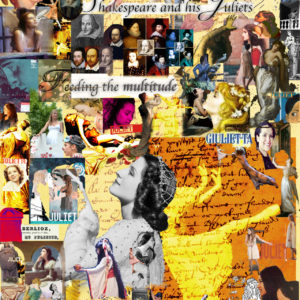
William Shakespeare went to high schools where the latin classics were taught. Shakespeare’s interest in Roman history typified the more general Renaissance fascination with the classical world.
Set in the earliest days of the Roman Republic, William Shakespeare’s Coriolanus is a dramatic exploration of the tensions inherent in a society transitioning from monarchy to republic, where the concentration of power in the hands of a patrician elite clashes with the demands of a growing, increasingly assertive popular class. The plot centers on this class conflict between the political, military and economic elite (the patricians) and the poorer but more numerous commoners (the plebeians). The recent expulsion of Rome’s kings has created a power vacuum, and the two classes now fight over whether elite opinion or popular opinion should prevail in the Roman city. Their inability to recognize their reliance on one another and their inability to think as a whole, for the greater good (rather than for the interests of their class or their own interest), is the tragedy described in the play. Those who use emotional speeches and those who use family ties to convince the ones who are the strongest militarily seem to be the ones effectively having power in the end because they decide whether the city has to fight wars or enjoy peace. Despite everything, at the end of the play, Coriolanus is a hero again, a warrior who defends the Republic, siding for peace and dying for it, but for how long?
Riots
The initial armed unrest depicted in the play stems from a food shortage. This shortage was caused by the elite’s practice of hoarding grains in order to sell them at a higher price later on. This causes starvation among the common population.
“If they would yield us but the superfluity while it were wholesome, we might guess they relieved us humanely. But they think we are too dear” (Act 1 sc.1 l.16–19)
The plebeians demand the right to set the price of grain, rather than accept a price imposed by the senate (the governing body, run by the patricians).
Shakespeare’s emphasis on the issue of grain has been attributed to the economic conditions of the early 17th century. The widespread high prices caused revolts in London. The situation in England was exacerbated by the issue of enclosures which had triggered a popular uprising in the Midlands in 1607, the presumed year of Coriolanus’s composition.
However, there had been royal edicts prohibiting the hoarding of grain for speculative purposes, particularly after the great famine of 1593–97. Given the similarities between the grain shortages experienced in Elizabethan England and those described by Plutarch in The Parallel Lives, it’s plausible that Shakespeare has seen a parallel between the two eras.
« They ne’er cared for us yet: suffer us to famish, and their store-houses crammed with grain; make edicts for usury, to support usurers; repeal daily any wholesome act established against the rich, and provide more piercing statutes daily, to chain up and restrain the poor. If the wars eat us not up, they will; and there’s all the love they bear us » Act 1 scene 1.
The patricians were indeed keen to keep the upper hand.
“[Coriolanus’s] mother, wife, his child, / And this brave fellow too [i.e., Cominius], we are the grains; / You are the musty chaff” (act 5 sc 1 l.33–35). This distinction between “the grains” and “the musty chaff” strongly echoes the biblical image of Christ as a winnower who separates the righteous (i.e., the wheat) from the wicked (i.e., the chaff).
“A harvestman that’s tasked to mow / Or all or lose his hire” (act 1 sc 3 l.39–40). Again, the harvest is associated with the superiority of the ruling class.
The patricians were born rich and have thus inherited an advantage over the others. Thanks to their families, they have a social network and land. This enables them to take the positions of political and economical power. They represent the elite. Whatever the regime, they maintain their position of power. The patricians see the tribunes and the plebeians as a threat to their authority. They view the plebeians, the commoners, as uneducated, unruly, and incapable of governing themselves.
Coriolanus portrays a failure of democratic principles to truly take root within the Roman system.
In the first act of the play, as the plebeians are on their way to the Capitol, they are intercepted by Menenius who tells the mob that the patricians have their best interests at heart. He compares the role of the senate in Rome to the role of the stomach in the human body. The stomach may seem idle and unactive but it serves as a storehouse for all the nutrients and then dispenses them throughout the rest of the body. Similarly, the patricians collect and dispense grain to the entire city. They are middlemen. With this tale, he tries to maintain the power as it is. Menenius’s speech offers an allegory of the “body politic,” a prominent Renaissance political theory that likened a kingdom or nation to the human body, effectively naturalizing the hierarchy of functions between the ruler and the ruled. Yet, Menenius tells this tale while the stomachs of the plebeians are empty and food is not redistributed. That is the all point of the rebellion in the first place. Later on, the play’s many floating references to body parts will build in turn a collective impression that the “body politic” of Rome is being dismembered.
“There was a time when all the body’s members
Rebelled against the belly, thus accused it:
That only like a gulf it did remain
I’ th’ midst o’ th’ body, idle and unactive,
Still cupboarding the viand, never bearing
Like labor with the rest, where th’ other instruments
Did see and hear, devise, instruct, walk, feel,
And, mutually participate, did minister
Unto the appetite and affection common
Of the whole body.” (Act 1 sc 1 l.98–108)
“The senators of Rome are this good belly, / And you the mutinous members” (Act 1 sc.1 l.157–58).
As a result of the rioting, the people are however granted tribunes to sit in the Senate. They are elected representatives with new powers to sit in the Senate.
War with the neighbouring Volscians halts the rioting.
In the battle for the town of Corioli, Caius Martius leads the Roman army with such spectacular bravery that he is honoured with the title ‘Coriolanus’. Upon his return to Rome, Coriolanus is given a hero’s welcome.
Coriolanus is so devoted to his family and to Rome that he finds the decision to grant the plebians representation intolerable. To him, it elevates plebeians to a status equal with his family and class. Caius Martius curses the mob, calling them dogs and cowards.
The Conflict Between Honor and Compromise
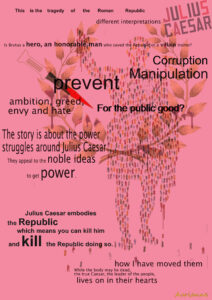
Back in Rome, the patricians and his mother urge Coriolanus to seek the consulship (the highest elected office). Reluctantly, he agrees to make the necessary public display of humility in order to win the favour of the citizens. His inability to mask his contempt turns the plebeians against him. At first, the common people agree to give him their votes, but they later reverse their decision after two clever tribunes, Brutus and Sicinius, describe Coriolanus as a potential tyrant — who would consequently silence the plebeians’ voice. In another of Shakespeare’s roman play, Julius Caesar, Julius Caesar is also accused of potential tyranny. There are no proofs that Julius Caesar may become a tyrant but Coriolanus does despise the plebeians, is it enough to call him a tyrant? Both are, on the contrary great defenders of Rome: “For your voices I have fought”. However this threat of potential tyranny enables the politicians to manipulate the crowds.
Brutus and Sicinius declare Coriolanus “a traitor to the people” (Act 3 sc.3 l.86) and drive him into exile.
As Menenuis puts it: “What has he done to Rome that’s worth his death? (…) The blood he hath lost / He dropped it for his country.” His actions are defending Rome. He is only guilty of speaking his mind.
This drives the proud Coriolanus into a fury. “Call me their traitor, thou injurious Tribune!” He speaks out intemperately against the very idea of popular rule. He says: “I banish you!” Of course, he’s the one who will physically leave Rome. But his language emphasizes that it’s the Romans who are in fact exiled and thus forced to live without the protection of one of their greatest “defenders”; they are now left to fend for themselves.
In revenge, Coriolanus turns his back and joins the Volscians and his former enemy Tullus Aufidius. Together they march on Rome. They are described by Volumnia as “a fearful army, led by Caius Martius.” Coriolanus is the difference in battle, and that’s what the people had forgotten.
Coriolanus embodies the traditional Roman values of honor, duty, and martial prowess. He has been raised by his mother to be the best warrior. Volumnia clarifies that her zeal for a warlike son is closely tied to her desire for a strong republic. However, these values clash with the pragmatic compromises necessary for effective governance in a republic. The patricians are reluctant to share power with the plebeians, and Coriolanus, initially, is resistant to the idea of compromising his traditional values. His lack of social skills is seen by the plebeians as arrogance and he is thought to be an uncivilized tyrant. His inability to compromise and act the part of a politician leads him to join the opposing side. Because of his “thankless country”, he undergoes a dramatic shift, transitioning from a respected hero to a traitor.
William Shakespeare is exploring the inherent difficulties of giving more power to the people (the pleb) within a society deeply rooted in hierarchy and tradition. Coriolanus also explores the challenges of leadership in a republic.
Coriolanus’s prowess in battle and sense of honour would seem to make him an ideal hero for the masses. However, he utterly lacks the necessary understanding of the common people and his fear of popular rule allows him to be regarded as “the people’s enemy”. He lacks wisdom and introspection (no soliloquy). He is seen as a beast, a dragon for example, or as a god but not a political animal. “He leads them like a thing made by some other deity than nature”. The pleb has “banish[ed] [their] defenders” into an enemy, not a very clever move. “in a violent popular ignorance, [they have] given [their] enemy [their] shield” But one can also wonder if choosing the perpetrator of massacres as a ruler is the best idea. He is “a worthy officer in the war” but does Coriolanus have the qualities to rule? The representants of the pleb, Cominius and Menenius, relish when Coriolanus marches on Rome. Neither Coriolanus nor the pleb or their political representants compromise and this leads to a dangerous situation for all of them.
The Instability of Popular Opinion
The play highlights the effectiveness of rhetoric, manipulation, and the exploitation of perceived threats to established power in swaying popular opinion.
Coriolanus’s expulsion seems to be a clear warning about the dangerous volatility of the popular will: the plebeians quickly bend under the tribunes’ manipulation instead of considering Coriolanus’s service to his country. A college professor asks: “Consider you what services he has done for his country?” However, while his exile seems unjust, just because he is proud, Coriolanus remains manifestly unsuited for the consulship, in both character and temperament: he is angry, proud and contemptuous. People think he is a honorable hero defending the Republic but he turns against them, allying with the enemy. He is self sufficient: “Alone I did it”. Coriolanus is blind to his reliance from the community: he goes from one city to another. He is not the “author of himself”. He doesn’t understand he needs the pleb as much as the pleb does not understand they need him.
Thus, the play vividly presents political issues while refraining from taking sides.
Coriolanus explores how the control and manipulation of “voices” are essential to maintaining power. The word voice had two meanings. The primary meaning was the same as it is today and related to the sound a person produces with their throat and mouth. It is the way through which actors or politicians express themselves. The secondary meaning related to a formal indication of choice — a meaning we today express with the word vote. The ability to articulate one’s position effectively is crucial in the political arena, as it is on a stage. The play portrays the political arena as a performance space, where individuals must adopt appropriate roles, costumes and voices to succeed but also need to captivate an audience to be relevant. All the actor’s parts create a whole, a play. This highlights the artificiality of political discourse and the importance of rhetoric in shaping public opinion.
Coriolanus is eloquent when leading soldiers in the battlefield. His military prowess and his inherent belief in his own authority give him at first a powerful voice and the pleb support him. However, he struggles to adapt his voice to the demands of republican politics. Coriolanus hates the idea of playing a role that doesn’t align with his sense of self. Coriolanus is only capable, as he puts it, of “play[ing] / The man I am” (act 3 sc 2 l.17–18). The play explores the tension between speaking authentically and performing a part to please the crowds. Volumnia dismisses her son’s complaint and insists that performing the part is easy. He doesn’t need to worry about what he thinks he should say; rather, he should simply stick to the script that is “but roted in / Your tongue.” This script may give “no allowance to your bosom’s truth,” but this shouldn’t concern him as long as he accepts that this is what being a politician entails: monstering his wounds, wearing the toga and saying what the people want to hear. Though her advice is realistic, Coriolanus views it as cynical, and he cannot abide by the thought of performing disingenuously. “Must I / With base tongue give my noble heart / A lie that it must bear?” He thinks action is eloquence but he is just a “speechless hand”. There is irony in the fact that the main character of the play doesn’t want to perform. Cordelia in King Lear doesn’t want to play a part either and she also wants to remain true to herself. She also loses political power because of that.
He has been raised to be a warrior. For him, there is more erotism in war than in the wedding night. He and Aufidius hate alike. He cannot play any other parts, he refuses to perform any other role: family man or politician. Volumnia insists that her grandson should also be raised to be a warrior.
Brutus and Sicinius, manipulate the masses into interpreting Coriolanus’s lack of social grace as a sign of a tyrannical personality, a person who will not listen to them, and so who will silence their voice. This belief underscores the double-sided nature of political speech, which can be made speak in favor of its own silencing.
“Get you hence instantly, and tell those friends
They have chose a consul that will from them take
Their liberties, make them of no more voice
Than dogs that are as often beat for barking
As therefor kept to do so”. (Act 2 sc. 3 l.237–41)
Indeed, even today, there is always a possibility in democracies that the people vote for a strong leader who, once elected, will not listen to them and behave like a tyrant and so denying democracy.
But, it is to be noted that, contrary to Coriolanus, the patricians and their allies actively seek to silence dissenting voices. They use threats, manipulation, and propaganda to undermine the authority of the tribunes and to discredit Coriolanus. This creates an atmosphere of fear and intimidation, making it difficult for alternative viewpoints to be expressed.
Voice seems to be more important than action to shape popular opinion. Indeed, Coriolanus has defended the Republic through his actions and he is true to himself, not acting a part, but he is discredited by people who are good at speeches, causing his banishment. Volumnia says : “I tell thee what fool hadst thou craft to banish him” and “Hadst thou craft / To banish him that struck more blows for Rome / Than thou hast spoken words?”
One would think the people would need protection thanks to military force more than words. This inability of the people to see Coriolanus’ protective actions puts them into danger due to the Volcians’ attack, led by their former hero.
Coriolanus then displays an apparently insatiable vengefulness against the state he idolized, opening a tragic divide within himself, pitting him against his mother and family, and threatening Rome’s very existence.
Two of Coriolanus’s oldest friends come to him, pleading for mercy, and asking him to “pardon Rome” but he refuses to hear them. He asks them “Away” and states ” Wife, mother, child, I know not”. But he does go back to his family and apologizes “like a dull actor now, I have forgot my part.” It is a speech from his mother, and not an action, that turns Coriolanus back to a peaceful Republic. Volumnia manipulates her son’s emotions. Coriolanus unilaterally decides to break off the attack on Rome. “though I cannot make true wars, / I’ll frame convenient peace”.
After this attack, the Republic recognizes at last Coriolanus’ heroism: “We have all great cause to give great thanks.”
Aufidius feels like Coriolanus’s “follower, not partner.” He stands that “he sold the blood and labor of our great action – Therefore shall he die.” Aufidius no longer address him by his honorific name while Coriolanus had told him before that “only that name remains”. Instead he calls him a “boy of tears” (Act 5 sc 6 l.119–20) as Coriolanus broke off their planned military campaign “for certain drops of salt” shed by his wife and mother. By stripping him of the honorific enshrined in the play’s title, Aufidius issues an implicit challenge to his sense of identity as a warrior. Aufidius conspires with some of his men to assassinate Coriolanus in Corioles — the site of Aufidius’s latest defeat and the city after which Coriolanus is named. This is an action from the Volscians, the last one of the play.
Coriolanus is unable to distinguish who are his friends and who are his ennemies. So does the pleb. There is a similar feature in King Lear where both Lear and Gloucester experience the same confusion: they are unable to tell genuine love from treacherous plotting within their own children and among their closest confidants.
The Illusion of Representation
The play reveals the enduring struggles that continue to shape political discourse and governance today.
The tribunes represent the primary mechanism for popular representation. They are the elected representatives of the plebeians. They should represent the commoners and their ideas. However, they fail to do so. Shakespeare demonstrates the limitations of this system of representation.
The play reveals that the people’s power is vulnerable to manipulation and exploitation when those who claim to represent them are themselves beholden to their own interests and those of the elite. The patricians constantly manipulate and undermine the tribunes, effectively silencing the plebeian’s voices and turning the tribunes into puppets. The tribunes are depicted as often ineffective.
This underscores the importance of communication and the power of language in shaping political outcomes.
It is difficult for the people to reach true representation in a system dominated by the wealthy and powerful.
The patricians’ belief in their own inherent right to rule is too strong to be challenged effectively. Coriolanus portrays a failure of democratic principles to truly take root within the Roman system. Despite the tribunes’ efforts and the occasional instances of popular support for the plebeians, the patricians ultimately maintain control. The play grapples with the question of the people’s power – or rather, the lack of it.
The patricians, with their economical and military powers, and experience in manipulating the political landscape, constantly undermine the tribunes’ authority. They manage to dictate the terms of public discourse.
This highlights the fragility of representation and the ease with which it can be subverted in a system where power is concentrated.
The play demonstrates that simply acknowledging the people’s voice is insufficient. The people’s voice is fragile in the face of powerful individuals. But the play also highlights the potential for conflict and instability that arise when power is concentrated in the hands of a privileged few.
While the patrician elite maintain a firm grip on the reins of power, the play reveals the potential for upheaval that arises when the demands of the common people are ignored or suppressed. The patricians, accustomed to absolute authority, find themselves navigating a more complex landscape, where popular opinion and the will of the people must now be considered.
Coriolanus suggests that the power of the people is not simply a matter of having a voice in the political process. It requires a more complex interplay of factors, including effective representation, access to information, and the ability to articulate one’s needs and desires.
Speeches unite the pleb. Speeches unite Shakespeare’s audiences. They move from one point of view to another during a representation.
General interest
The play portrays classes working for their own interests and not for a higher purpose. The banishments of Coriolanus serves the private interests of most but it hurts the public interest as the city is in danger. Coriolanus is an essential element, an arm, a limb that the Romans do need.
This is the tragedy of the common goal, where the separate parts can’t see themselves as a whole, as a political body.
The fact that the mob lacks a head, makes it lack rationality and leads to the fact that they cannot take a good decision for the whole body of politics. They are referred to as “The multi-headed multitude”. The politic system has “Given Hydra to choose an officer” (3.1.125)
This can be seen as a critique of the Republic aiming at greater good, while in reality, there are just classes seeking their own interests.
Force and power
The strongest economically, politically and militarily can’t be ignored but the people can’t be ignored either.
King James I and his son Charles liked to associate themselves with the image of imperial Rome and asserted an absolutist model of government.
Their opponents in Parliament often invoked the roman republic where the senate would hold consuls in checks and the tribunes who would held them in check. The house of Lords was compared to the Senate, and the house of Commons, the tribunes.
The play explores the difficulty of the people to be heard, despite their riots and this political representation.
The audience can ask itself many questions about power.
How can the people defend themselves? How can they defend themselves against those who starve them? How can they defend themselves against another city which attacks them?
Who should they choose to represent them: a strong soldier or a politician? In the end neither do not serve their interests? What qualities must have representants of the people? Should they be elected?
Is it democratic to vote for a tyrant? How can the people know if the person they vote for will become a tyrant?
How can the people reduce the influence of the elite and the influence of their emotional bond to their families? How can the people rule when they change their minds according to who speaks the best? Who is heard and who is unheard?
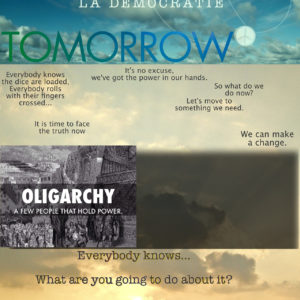
How can the powerful be in check by the people? How can power will be more balanced between the strong ones (economically, military and politically) and the people?
Is the elite really self-made? Doesn’t their success also depend on the community?
What kind of political system would work for the interest of society as a whole? How can the particular interests be less heard?
The play reveals the dangers of unchecked ambition and the corrosive effects of power. Caius Martius, now Coriolanus, allows his ambition to consume him. His desire for power and glory ultimately leads him to betray the trust of his fellow Romans and to incite a rebellion against the state. This serves as a cautionary tale about the importance of ethical leadership and the need to prioritize the common good over personal ambition.
Despite the tribunes’ efforts and the occasional instances of popular support for the plebeians, the patricians ultimately maintain control. But Shakespeare also states: “What is the city but the people?” (Sicinius, Act 3 Scene 1). He shows both sides: the dangers of a power kept in few hands and the dangers of letting a fickle mob decide. ” Trust ye / With every minute you do change your mind, / And call him noble that was now your hate, /Him vile that was your garland”.
The middle men are lazy and doing nothing much but they are indeed strong. The people are the ones making the Republic work, they are more numerous but they are weak. They gain very little from their riot: the illusion of representation. They change their minds quickly, go in every directions are thus unable to make their claims heard: more food, more protection.
The body politics need all its parts: the head, the stomach, the heart and all the other limbs to act in one direction thanks to the blood.
The play has been adopted by the political Left and Right with equal enthusiasm at various points in history and has been played both as a leftist and a right-wing piece, depending upon the director’s inclinations. Thus, the work’s subtle ambiguities of statement continue to fuel discussion.
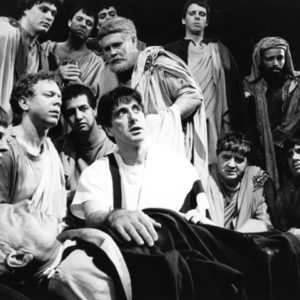
There has been some fascist productions showing Coriolanus as a strong leader and anti-fascist productions stressing the dependency of Coriolanus to the people.
It is a play that continues to resonate with audiences centuries later, prompting us to reflect on the enduring challenges of political leadership and the importance of safeguarding the voice of the people.
It is a play about the forces that are at work when people live together, in a society.
This text also resonates with the text of Gorgias by Plato. Gorgias is proud to be able to have more power just thanks to his eloquence. Socrates warns him that this leads a lesser society as this serves his own interests rather than the greater good. Callicles joins the dialogue to challenge Socrates on what is good. He advocates for the sacrifice of the many so that a few achieve a greater humanity. Don’t we weed out the gardens? Don’t we breed the best horses? Socrates barely wins the debate by reminding Callicles that the elite need the whole of society to function.
Coriolanus – Wikipedia: https://en.wikipedia.org/wiki/Coriolanus
Coriolan (Shakespeare) – Wikipedia: https://fr.wikipedia.org/wiki/Coriolan_(Shakespeare)
Coriolanus William Shakespeare – Sparknotes: https://www.sparknotes.com/shakespeare/coriolanus/
Coriolanus – Folger Shakespeare Library: https://www.folger.edu/explore/shakespeares-works/coriolanus/read/
Coriolanus – Ralph Fiennes – 2011 – imdb: https://www.imdb.com/title/tt1372686/?ref_=mv_close

Coriolanus – Josie Rourke & Tim Van Someren- 2014 – imdb: https://www.imdb.com/title/tt3313066/?ref_=nv_sr_srsg_3_tt_8_nm_0_in_0_q_coriolanus