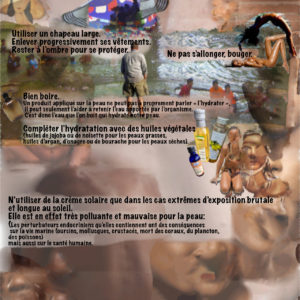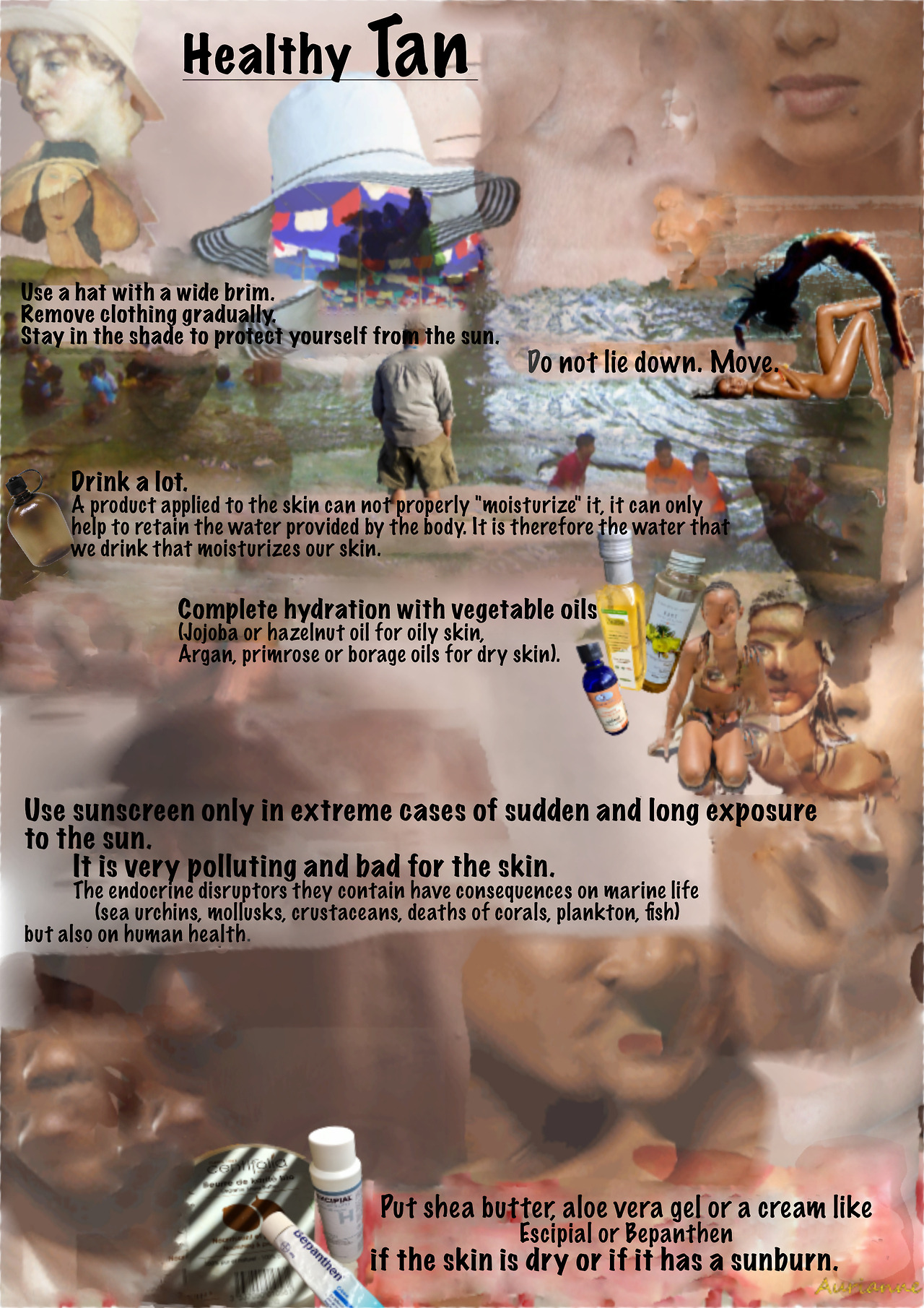
Gradually expose yourself to the sun. Wear wide-brimmed hats, gradually remove layers of clothing, and stay in the shade to protect yourself.
Don’t lie down; keep moving.
Make sure to drink well
A product applied to the skin cannot, strictly speaking, “hydrate” it; it can only help the skin retain the water supplied by the body (so it is the water we drink that hydrates our skin).
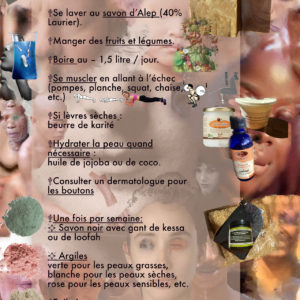
Supplement hydration with plant-based oils, such as jojoba or hazelnut oils for oily skin, and argan, evening primrose, or borage oils for dry skin.
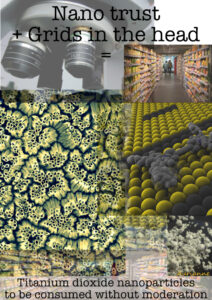
Use mineral-based sunscreen only in extreme cases of sudden and prolonged sun exposure: petrochemical-based sunscreens are highly polluting and harmful to the skin. The endocrine disruptors they contain have consequences for marine life (sea urchins, mollusks, crustaceans, and the death of corals, plankton, and fish) as well as for human health.
Apply shea butter, aloe vera gel, or a cream such as Excipial or Bépanthen if your skin is dry or sunburned.
Comment utiliser l’aloe véra – Doctissimo: https://youtu.be/KjjaPNvNx_U
Environment Health Perspective – Sunscreens damage coral: http://www.sehn.org/tccpdf/sunscreens%20damage%20coral.pdf
In short, the organic UV filters found in petrochemical-based sunscreens cause coral bleaching by promoting the replication of a virus present in symbiotic zooxanthellae (single-celled algae without which tropical corals cannot survive). The proliferation of this latent virus causes the death of the zooxanthellae and, consequently, the death of the corals after more than three months of bleaching.
On the underwater trail at Île aux Canards, for example, it’s recommended to wear Lycra for protection; or, if that’s not possible, keep your T-shirt on, or apply mineral-based sunscreen 20 minutes before entering the water (to allow it to absorb into the skin)—applying it only to your back—or apply it only after getting out of the water. Even in the water, you’re still quite exposed to UV rays, so you need to be careful—especially if you have fair, blond, or red hair!
In New Caledonia, with the massive influx of tourists arriving on cruise ships—Australians in particular—people are very aware of UV-related issues and therefore take precautions! While Lycra clothing is commonly worn, applying sunscreen can be crucial in specific areas: the Jinec Natural Aquarium near Easo, Duck Island, etc.—that’s where the catch is! Taking proper precautions beforehand (on the boat, but also before swimming) is highly recommended!
Consommons sainement: https://consommonssainement.com/2016/12/10/alternative-naturelle-cremes-hydratantes/
Consoglobe: https://www.consoglobe.com/tout-sur-la-creme-solaire-cg
France Nature environnement: https://www.fne.asso.fr/com/santa/page_eau_a26.pdf
Collectif des Associations de Défense de l’Environnement du Pays-Basque et du sud des Landes: https://www.cade-environnement.org/2017/06/26/eau-et-nanoparticules-un-risque-emergent/
Translated with DeepL